How to Build a Schedule for Firefighters
Build a schedule for firefighters around minimum staffing, qualifications, rotations, leave, trades, overtime, call-offs, and volunteer availability.
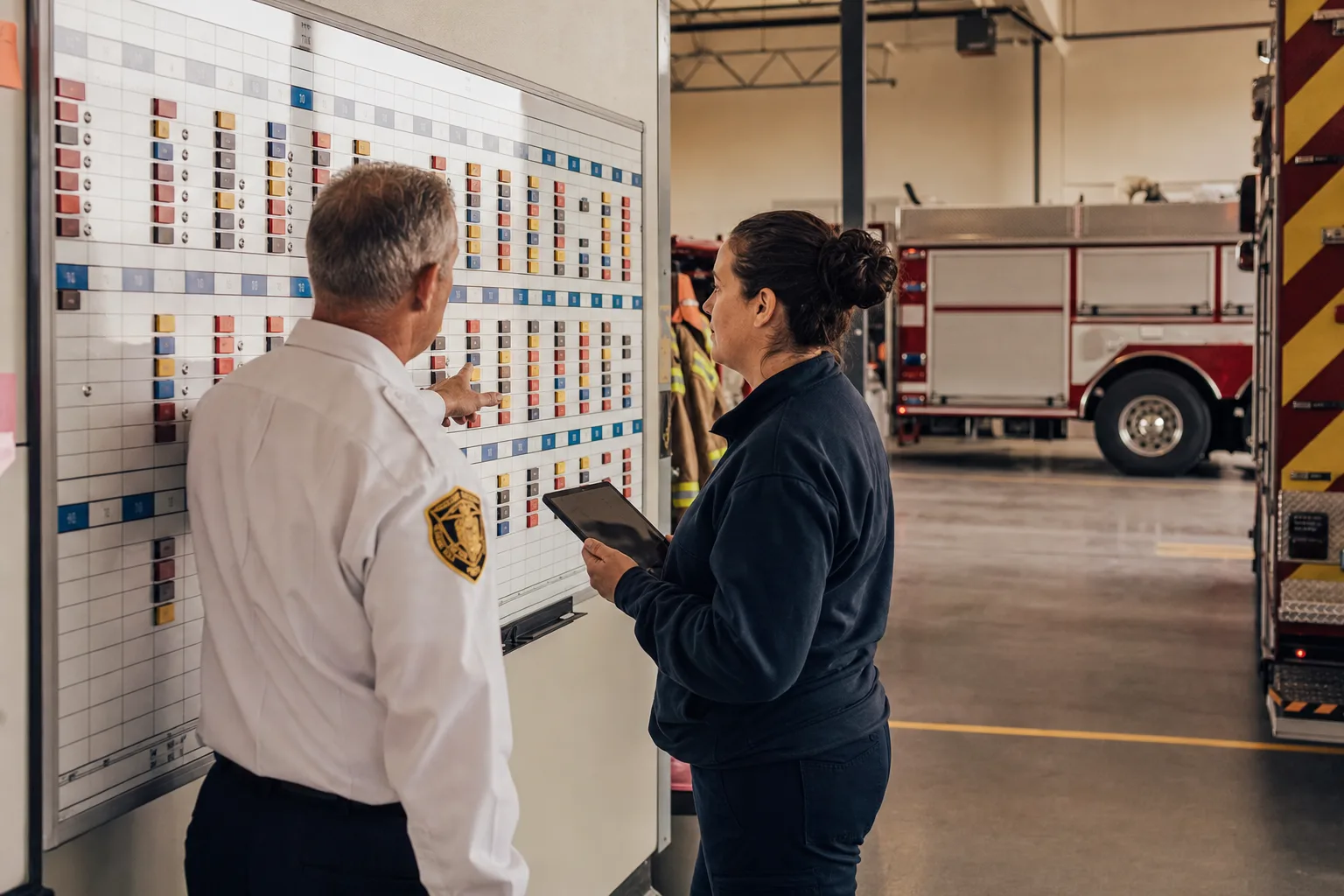
A workable schedule for firefighters starts with coverage requirements, not a calendar template. Define how many members and which qualifications each station, apparatus, or duty crew needs. Then apply the department’s shift rotation, approved leave, vacancies, restrictions, volunteer availability, and trade rules. Validate every shift before publication, including officer, driver/operator, medic, and other required assignments.
The schedule must also remain workable after publication. Call-offs, emergency leave, training, injuries, and major incidents can change coverage quickly. Departments therefore need a repeatable process for identifying gaps, contacting eligible members, approving changes, and documenting who made each decision.
Start with the department’s coverage rules
Before assigning names, establish the requirements the schedule must satisfy. These requirements may come from department policy, labor agreements, staffing plans, mutual-aid commitments, or the authority having jurisdiction.
A minimum staffing level is the lowest approved number of on-duty members for a defined unit, station, battalion, or department. A department-wide head count alone may not be enough. Twelve members on duty can still leave an engine out of service if no qualified driver/operator is assigned to it.
Build a coverage matrix that answers four questions for every scheduling period:
- How many members must be on duty?
- Where must they be assigned?
- Which qualifications or ranks are required?
- Which apparatus or functions may be browned out, cross-staffed, or reassigned under approved policy?
| Coverage layer | Example requirement | Scheduling check |
|---|---|---|
| Department | 14 members on duty | Count all deployable personnel, excluding members unavailable for operations |
| Station | Minimum of four at Station 1 | Confirm actual station assignment, not merely shift membership |
| Apparatus | Engine staffed with an officer, driver, and firefighters | Prevent one person from filling two simultaneous riding positions |
| Medical capability | At least one paramedic on a designated unit | Confirm current, department-recognized qualification |
| Command | One battalion chief or approved acting officer | Record acting assignments and approval |
| Specialty function | Qualified aerial operator assigned when the truck is in service | Check qualification and any department restrictions |
Departments creating or revising these rules can use a structured minimum staffing process. Staffing levels and apparatus deployment decisions may involve safety standards, collective bargaining, local regulations, or other authority. Each department must verify those issues with its own counsel, labor representatives, safety officer, and authority having jurisdiction.
Select a rotation that matches the operating model
The base rotation determines when regular crews are expected to report. Common arrangements include A/B/C crews, four-platoon systems, 24-hour shifts, and longer rotations such as 48 hours on followed by 96 hours off. The right pattern depends on staffing, workload, leave use, fatigue controls, labor agreements, and local operating conditions.
A rotation should be evaluated across a full cycle rather than a single week. Check:
- Average scheduled hours over the applicable work period
- Weekends and holidays distributed across crews
- Required relief or debit days
- Shift-change times and reporting expectations
- Training days that overlap operational assignments
- Movement between stations or platoons
- Vacancies created by promotions, transfers, and academies
- Recovery time after overtime or callback assignments
For an example of a longer platoon cycle, see the 48/96 firefighter schedule. Departments comparing patterns should also distinguish scheduled hours from hours actually worked; holdovers, callbacks, trades, and overtime can materially change an individual member’s workload. The guide to firefighter work hours explains that distinction.
Rotation changes may affect FLSA work periods, overtime calculations, labor obligations, fatigue controls, and union-contract provisions. Departments must verify those matters with qualified counsel and the applicable labor and safety authorities before implementation.
Build the schedule in operational layers
Trying to place every member, qualification, leave request, and exception at once makes errors difficult to find. Build the schedule in layers so each decision can be checked.
1. Create the scheduling period
Choose a publication horizon that fits the department. A monthly calendar may be convenient for leave and training, while the underlying A/B/C rotation may run continuously for years. Maintain a consistent shift-change time and define whether an overnight shift is labeled by its start date or end date.
Avoid rebuilding recurring assignments manually each month. Generate the base rotation first, then apply exceptions. This prevents a copied cell or missed date from putting an entire crew on the wrong shift.
2. Load roster and qualification data
Each schedulable member should have a current record containing:
- Rank and acting-rank eligibility
- Crew, platoon, and regular station
- Driver/operator or apparatus qualifications
- EMS level when it affects deployment
- Specialty-team eligibility when required for staffing
- Employment or membership status
- Approved restrictions that schedulers are authorized to use
- Availability rules for volunteers or part-time members
Do not treat a certification list as proof that a member is deployable in every role. A department may require local checkout, task-book completion, medical clearance, or officer approval in addition to a credential. The scheduling record should reflect the department’s approved eligibility decision.
3. Place regular crews and riding assignments
Add the normal platoon to each shift, then assign stations, apparatus, and riding positions. A riding assignment is the operational seat or function a member fills, such as engine officer, driver, firefighter, or medic.
For multi-station departments, validate both the total head count and the distribution. If Station 2 has no qualified driver, an extra firefighter at Station 1 does not automatically resolve the gap. Any temporary transfer should be visible on both the member’s schedule and the station roster.
4. Apply leave and known absences
Enter approved vacation, holiday leave, military leave, training, light-duty status, and other known absences before offering discretionary open shifts. Use one recognized approval path so a leave request cannot be approved in email but remain absent from the operational schedule.
When reviewing leave, calculate the effect on qualifications as well as head count. Approving leave for two members may be numerically acceptable but still remove the shift’s only aerial operator or paramedic.
5. Fill vacancies through a defined order
A vacancy process should state who is contacted, in what order, and who approves the assignment. Depending on department policy, options may include reassignment, an eligible volunteer duty crew, part-time staff, an open-shift notice, overtime, callback, or an approved apparatus status change.
Only notify members who are eligible for the actual assignment. An open driver shift should not generate a general alert to members who cannot operate that apparatus. Qualification-based pools reduce irrelevant messages and help the scheduler focus on viable responses.
If no qualified member accepts, escalate according to the department’s understaffing procedure. The scheduler should never have to invent a response while a shift is approaching minimum staffing.
6. Validate and publish
Run a final check for every shift before release:
- Required staffing by station and unit
- Officer and acting-officer coverage
- Driver/operator and EMS qualifications
- Duplicate or overlapping assignments
- Approved leave correctly removed from deployable staffing
- Transfers shown at the receiving and originating stations
- Open vacancies clearly identified
- Overtime or special-duty coding applied consistently
- Publication date and schedule version recorded
Publish through one authoritative schedule. Printed station copies can support daily operations, but they should identify when they were generated so personnel do not mistake an old printout for the current roster. A shared firefighter shift calendar is most useful when changes are controlled and members receive updates.
Set rules for trades, overtime, and call-offs
Shift trades
A trade should not become valid merely because two members agree. Require officer or scheduler approval and confirm that the replacement preserves rank, qualifications, rest rules, and station coverage. The department should also define whether a trade changes payroll records, overtime eligibility, or only the work assignment.
A practical shift-swap policy should address submission deadlines, partial-shift trades, repayment expectations, cancellations, and responsibility if the replacement member fails to report.
Overtime and holdovers
Maintain an approved method for offering and assigning overtime. The process may use a rotating list, equalization rules, seniority, availability, mandatory overtime, or another locally approved system. Record offers, responses, assignments, refusals when policy requires them, and the reason an exception was made.
Do not allow the scheduling calendar to become the only payroll record unless the department has adopted and validated that workflow. Scheduled time, worked time, callback time, and compensated time can differ.
FLSA treatment, including any use of the Section 7(k) work-period provision for qualifying fire-protection employees, must be verified with the department’s counsel or payroll authority. Union-contract requirements and state wage-and-hour rules also require local review.
Last-minute call-offs
A call-off procedure should identify whom the member contacts, what information is recorded, who begins backfill, and when the issue escalates. Supervisors should avoid collecting unnecessary medical details in the scheduling record.
Use a consistent sequence:
- Record the absence and effective time.
- Recalculate head count and qualification coverage.
- Determine whether a temporary reassignment resolves the gap.
- Notify the correct eligible pool.
- Apply overtime or callback rules.
- Escalate if the vacancy remains open.
- Update the authoritative schedule and station officer.
The last-minute call-out policy guide provides a fuller framework.
Account for career, combination, and volunteer staffing
Career staffing is usually rotation-driven: members belong to a regular crew, and exceptions modify that assignment. Volunteer staffing is often availability-driven: members indicate when they can serve, and officers build duty crews or response coverage from that pool. Combination departments may need both models on the same date.
For volunteer availability, collect specific time windows rather than a simple available/unavailable response. A member may be available from 1800 to 0600 but unable to cover the daytime portion of a 24-hour duty period. Track qualifications alongside availability so six available members are not mistaken for a complete crew when none can drive the first-due engine.
Guidance on employee availability management can be adapted to part-time and volunteer rosters. Combination departments should label scheduled station duty, on-call availability, and general incident response separately. Those statuses are not interchangeable.
Know when scheduling software becomes useful
A spreadsheet may be workable for one station, a small roster, and a stable rotation if a designated person controls edits and validates coverage. It becomes harder to manage when the department has multiple stations, frequent trades, several qualification rules, volunteer availability, or many open shifts.
A dedicated scheduling layer can reduce manual work when it supports:
- Recurring custom rotations and shift types
- Officer-approved swaps and time-off requests
- Open shifts sent only to qualified members
- Scheduled-versus-required coverage views
- Crews, stations, and temporary transfers
- Web and mobile access with change notifications
- An audit trail for approvals and schedule edits
- Optional timekeeping when the department needs it
Scheduling software does not replace CAD, paging, incident reporting, certification management, or command judgment. It should provide a reliable staffing picture and controlled workflow. Departments evaluating the change can review the operational considerations in fire department scheduling software.
Use a maintenance rhythm after publication
A schedule is a live operational plan. Assign ownership and review it at predictable intervals.
Daily review
The duty chief or designated officer should confirm current staffing, riding assignments, known absences, overtime, and apparatus status around shift change. Any discrepancy between the published schedule and actual lineup should be corrected promptly.
Weekly review
Look ahead for leave clusters, academy commitments, training, special events, vacancies, and qualification shortages. Opening shifts early usually gives eligible members more practical response time than waiting for the preceding shift.
Monthly or cycle review
Examine recurring gaps, overtime concentration, unfilled volunteer periods, transfer frequency, and where scheduled staffing repeatedly falls below required coverage. These patterns may indicate a roster, qualification, leave-policy, or deployment issue rather than a calendar problem.
Implementation checklist
- Document minimum staffing by station, apparatus, and function.
- Define required ranks and qualifications for each riding position.
- Select and verify the full shift rotation.
- Confirm FLSA, labor, union-contract, payroll, and safety implications with the proper authorities.
- Clean the roster and remove expired or unapproved eligibility records.
- Enter regular crews before adding exceptions.
- Establish one process for leave, trades, overtime, and call-offs.
- Create qualified contact pools for common open-shift types.
- Define escalation when no eligible member accepts a vacancy.
- Validate head count and qualifications before publication.
- Identify one authoritative schedule and control editing access.
- Notify members when approved changes affect their assignments.
- Review actual staffing at shift change.
- Audit recurring shortages and administrative bottlenecks after each cycle.
The strongest schedule is not the one with the most complicated rotation. It is the one that clearly connects each member to a shift, station, apparatus, and qualified role—and provides a controlled way to respond when that plan changes.
Frequently Asked Questions
- What information is needed to build a schedule for firefighters?
- Start with the shift rotation, roster, station and apparatus requirements, minimum staffing, required ranks, qualification eligibility, approved leave, vacancies, and availability. Also document the department’s rules for trades, overtime, callbacks, acting assignments, and temporary transfers.
- How far in advance should a firefighter schedule be published?
- The publication horizon should match the department’s leave process, labor agreement, staffing model, and operational needs. Many departments use a monthly view while maintaining a continuous underlying rotation. Predictive scheduling or fair-workweek rules may apply in some jurisdictions, so departments must verify notice requirements with their own counsel or authority. See the [predictive scheduling laws overview](/posts/predictive-scheduling-laws-overview/) for issues to review.
- How should qualifications be handled when filling an open shift?
- Match the vacancy to the actual riding position and notify only eligible members. For example, a driver/operator vacancy should go to members approved for that apparatus or assignment. After someone accepts, revalidate the whole shift because moving one qualified member can create a gap at another station or unit.
- When should a fire department move beyond spreadsheets?
- Consider dedicated scheduling software when multiple stations, frequent call-offs, qualification rules, open shifts, volunteer availability, trades, or simultaneous editors make the authoritative schedule difficult to maintain. The deciding issue is whether the current process can reliably show scheduled-versus-required coverage and control approvals without duplicate data or missed changes.
Ready to replace the spreadsheet and group text?
Build the rotation, publish shifts, and see qualified coverage in ShiftSynch.
Start free