Firefighter Shift Calendar: Build and Maintain Coverage
Learn how to build and maintain a firefighter shift calendar for crew rotations, station coverage, leave, trades, overtime, and qualifications.
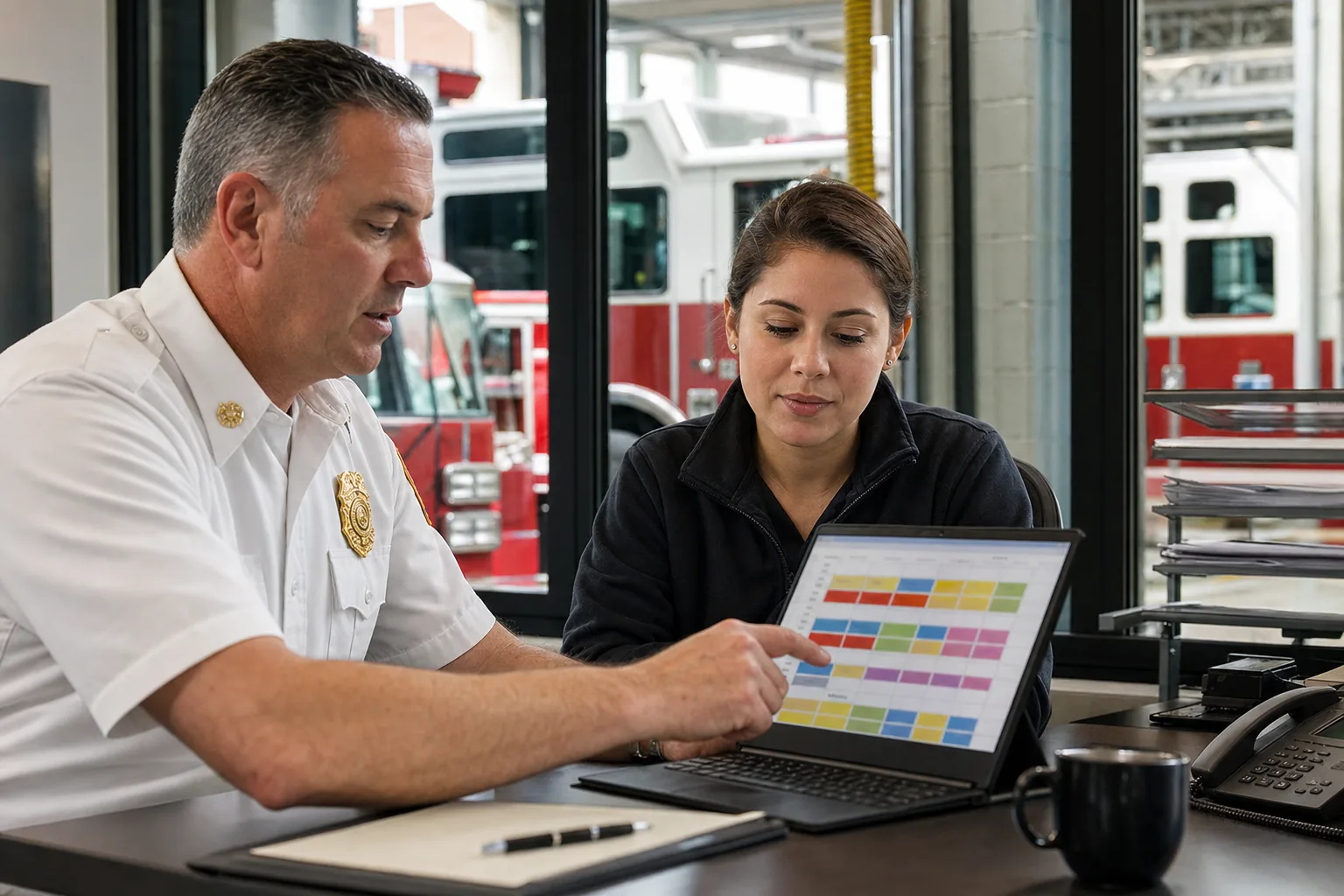
A firefighter shift calendar should show more than who is working. It must connect crew rotations, station assignments, apparatus roles, minimum staffing, leave, trades, call-offs, overtime, and qualifications in one controlled schedule. Department leaders need to see whether every station and duty position is covered—not simply whether enough names appear on a date.
Building that calendar requires clear staffing rules, approval workflows, and one authoritative version. Maintaining it requires disciplined updates whenever leave, swaps, vacancies, or operational needs change. When spreadsheets and shared calendars cannot reliably show qualified coverage or preserve approved changes, a dedicated fire-service scheduling system can provide stronger control and visibility.
What a firefighter shift calendar must show
The calendar is the department’s operational staffing plan for a defined period. Depending on the organization, it may cover 24-hour platoons, 12-hour duty crews, daytime staffing, volunteer duty nights, peak-demand units, or combinations of these arrangements.
At minimum, each scheduled assignment should answer five questions:
- Who is assigned? Identify the member, not merely the crew or position.
- When are they assigned? Include the shift’s exact start and end times.
- Where are they assigned? Show the station, apparatus, duty crew, or operational area.
- What role are they filling? Examples include company officer, driver/operator, firefighter, or medic.
- Does the assignment satisfy the staffing requirement? Headcount alone may not meet a company-level or station-level requirement.
A calendar is not necessarily the same as a daily staffing board. The calendar establishes assignments across days, weeks, or months. A staffing board may present the current shift by station and apparatus after details, trades, overtime, and call-offs have been resolved. Departments can use both views, but they should draw from the same approved scheduling record.
The calendar also should not be treated as an incident reporting, CAD/dispatch, paging, asset, or certification-record system. Those systems have different operational purposes. Scheduling software may use a member’s qualifications to determine eligibility, but the department still needs an authoritative process for maintaining certification and qualification records.
Start with the department’s coverage model
Do not begin by copying names into calendar cells. First document the coverage structure the schedule must enforce.
For a career department, that structure might include A/B/C crews assigned to a repeating rotation, with a minimum number of members at each station. A combination department might pair a career officer and driver with volunteer or part-time staffing. A volunteer department might schedule duty crews for nights and weekends while also tracking general availability.
Departments developing continuous coverage can review the operational choices in 24/7 coverage scheduling. The rotation is only one part of the design; the calendar must also account for relief, leave, vacancies, training, and special assignments.
Define requirements at the right level
A department-wide minimum such as 12 members on duty may be inadequate if the calendar does not identify where those members are needed. Coverage rules may need to be defined at several levels:
| Coverage level | Example requirement | Calendar question |
|---|---|---|
| Department | 12 operational members on duty | Does the shift meet total headcount? |
| Station | At least three members at Station 2 | Is each station staffed as required? |
| Apparatus | Officer, driver/operator, and firefighter on an engine | Are required seats and roles filled? |
| Qualification | At least one department-authorized medic on a unit | Is a qualified member assigned? |
| Time segment | Additional unit from 08:00 to 20:00 | Does coverage match the required hours? |
Minimum staffing is a department policy and labor-relations issue, not a universal number. Chiefs and administrators should confirm requirements with their governing authority, collective bargaining agreement, mutual-aid commitments, medical authority, and applicable safety rules. The process in setting minimum staffing levels can help organize those decisions.
Map rotations before adding exceptions
Enter the base rotation for each crew or team before processing individual changes. For example, if A, B, and C crews rotate through 24-hour shifts, verify the pattern over enough weeks to catch transition errors, leap days, and year boundaries. If Kelly days or other scheduled relief days are used, represent them explicitly rather than relying on supervisors to remember them.
For more context on common rotation structures, see firefighter scheduling and how many hours firefighters work. Actual work periods and pay treatment depend on department policy and applicable agreements.
Build leave, trades, and overtime into the workflow
A usable calendar must distinguish a base assignment from later changes. If every revision simply overwrites the original cell, administrators may be unable to determine why a vacancy appeared, who approved a trade, or whether overtime was authorized.
Process leave against projected coverage
A leave request should be evaluated against the coverage expected for the affected shift. The decision may depend on:
- Approved leave already on the calendar
- Members scheduled for training or special assignments
- Station and apparatus minimums
- Required officer, driver/operator, or medic qualifications
- Known vacancies or restricted-duty assignments
- The department’s leave-priority and approval rules
Approval should update the same calendar used by supervisors and members. A request marked approved in an email but absent from the operational schedule creates two competing records.
Treat trades as controlled assignment changes
A trade is not complete merely because two firefighters agree. The department may need to verify that the substitute can work the station, apparatus, and role involved; that the exchange follows policy; and that an authorized officer approves it.
A sound workflow records the requesting member, proposed replacement, affected shifts, qualification check, approving officer, and final schedule update. Departments should define those rules in a written process such as a shift swap policy.
FLSA and labor notice: The pay, overtime, work-period, substitution, and recordkeeping treatment of firefighter trades can be fact-specific. Departments must verify their procedures with their own counsel, payroll authority, and applicable union contract. Scheduling approval does not by itself establish the proper payroll treatment.
Fill vacancies by role, not only by availability
When leave or a call-off creates an opening, identify the actual vacancy: for example, Station 1 engine driver/operator from 07:00 Monday to 07:00 Tuesday. An announcement for “one person needed” may attract members who cannot fill the required role.
A qualified pool narrows notifications to eligible members based on department-defined criteria. Eligibility might consider rank, driver authorization, medical qualification, station restrictions, scheduled conflicts, or other approved rules. Availability helps identify possible candidates, but it should not override qualifications or approval requirements. See employee availability management for ways to collect and use availability without treating it as a guaranteed assignment.
Overtime assignments should retain the reason for the vacancy, offered shift, selected member, authorization, and resulting schedule. Any overtime list, rotation, equalization rule, or mandatory callback procedure must follow the department’s policy and applicable labor agreement.
Manage call-offs without losing calendar control
Last-minute call-offs expose weak scheduling processes quickly. A supervisor may receive a phone call, send a group text, write a name on a station board, and forget to update the master calendar. The incoming chief then sees a different roster from the crew actually working.
A controlled call-off process should include:
- Record the absent member and affected assignment.
- Recalculate coverage at the station, apparatus, role, and department levels.
- Determine whether reassignment can resolve the gap.
- Open the vacancy to the appropriate qualified pool.
- Apply callback, overtime, or mandatory-fill rules in the required order.
- Obtain authorization and place the selected member on the calendar.
- Notify affected stations, officers, and members.
- send the approved time information to payroll or timekeeping processes.
The department’s last-minute call-outs policy should identify who can accept a call-off, who can authorize backfill, and how unsuccessful contacts are documented. If no eligible replacement is available, leaders need an escalation plan for handling understaffing, including who may move companies, place an apparatus out of service, request mutual aid, or take another department-authorized action.
Safety and authority notice: Apparatus status, company staffing, member qualifications, and emergency coverage decisions must be verified under the department’s own policies, medical direction, governing authority, and applicable safety requirements. A calendar can identify a potential gap; it does not replace command judgment.
Recognize when shared calendars and spreadsheets are failing
Spreadsheets can support a small or stable schedule, but complexity increases when several people edit assignments, qualifications affect eligibility, and changes occur around the clock. A shared consumer calendar may communicate dates while providing little control over staffing logic.
Warning signs include:
- Supervisors keep separate station copies of the schedule.
- Members cannot tell whether a trade is requested, approved, or final.
- Leave is tracked in email while staffing is tracked in a spreadsheet.
- Color coding carries essential meaning that is not documented.
- Formulas count people but not officers, drivers, or medics.
- A change is made without recording who approved it.
- Call-offs are filled by text but not added to the master calendar.
- Administrators manually compare several files to prepare payroll.
- Members receive an outdated PDF after the schedule changes.
- Only one person understands the spreadsheet’s formulas or macros.
The central problem is usually not the spreadsheet format. It is the lack of a controlled workflow connecting requests, eligibility, approvals, coverage calculations, notifications, and time records.
Choose a dedicated scheduling approach carefully
Fire-service scheduling software should match the department’s actual coverage model. A product that displays shifts but cannot represent custom rotations, multiple stations, qualification rules, or officer-approved changes may simply become another calendar to maintain.
Useful capabilities to evaluate include:
- Custom rotating schedules and shift types
- Crews or teams such as A/B/C platoons
- Station, apparatus, and role assignments
- Scheduled-versus-required coverage views
- Qualifications-based assignment eligibility
- Officer-approved trades and swaps
- Open shifts with qualified-pool notifications
- Availability and time-off requests
- Web and mobile access
- Push, email, or in-app schedule notifications
- Optional timekeeping when the department needs it
ShiftSynch is a dedicated scheduling layer for career, combination, and volunteer fire departments and supports these functions. It is not an RMS, NFIRS or incident-reporting system, CAD/dispatch tool, paging platform, asset system, or certification-expiry tracker. Departments should define which system owns each type of information before implementation.
Implement the calendar in controlled stages
Software does not correct unclear policies. Configure the schedule only after leaders agree on rotations, coverage rules, approval authority, and exception handling.
Implementation checklist
- Name the authoritative schedule and retire unofficial copies.
- Document every shift type, including start and end times.
- Enter crews, stations, apparatus roles, and recurring rotations.
- Define required headcount and qualifications at the appropriate level.
- Verify member eligibility data against authoritative department records.
- Configure who can request, approve, edit, and publish changes.
- Establish workflows for leave, trades, call-offs, overtime, and open shifts.
- Decide which changes trigger member or officer notifications.
- Test overnight shifts, partial shifts, transfers, details, and multi-station assignments.
- Test coverage calculations after removing an officer, driver, or medic.
- Define how approved hours reach payroll or timekeeping.
- Train members, company officers, battalion-level supervisors, and schedulers by role.
- Run the new process in parallel only for a defined validation period.
- Set a cutover date after which the new calendar is authoritative.
- Review permissions, rules, and recurring schedules on a regular cycle.
Testing should use realistic exceptions rather than a perfect week. Enter a vacation, same-day sick call, two-person trade, training detail, station transfer, partial overtime shift, and vacancy requiring a specific qualification. Confirm that users see the correct assignment and that the coverage view responds as expected.
Establish communication and change-control rules
Members need to know where to look and what a calendar status means. Define whether an entry is proposed, pending approval, approved, or canceled. A notification should direct the recipient back to the current calendar rather than functioning as a permanent substitute for it.
Departments should also decide:
- How far ahead base schedules are published
- Who may alter a published assignment
- Which changes require direct acknowledgment
- How members report a suspected error
- Who reviews unfilled open shifts
- How schedule changes are communicated during system downtime
- How long scheduling and approval records are retained
Advance-notice obligations may arise from state or local scheduling laws, civil-service rules, department policy, or a collective bargaining agreement. Departments should review the predictive scheduling laws overview and verify applicability with their own counsel or authority. Fire-department exceptions and public-sector coverage vary by jurisdiction.
Audit the calendar as an operational system
A firefighter shift calendar is never finished after initial setup. Rotations, station assignments, qualifications, vacancies, and labor rules change. Assign responsibility for periodic audits rather than waiting for an uncovered position to reveal a configuration problem.
Review recurring rotations before each annual schedule is published. Audit user access when members change rank, station, employment status, or scheduling responsibility. Compare scheduled staffing with required staffing and investigate recurring shortages by station, weekday, qualification, or shift type. That analysis can identify where hiring, cross-training, leave controls, or different open-shift procedures may need leadership review.
The goal is one current, explainable staffing picture: who is working, where they are assigned, what role they can fill, what changed, who approved it, and whether coverage meets the department’s own requirements.
Frequently Asked Questions
- What should a firefighter shift calendar include?
- It should include shift start and end times, assigned members, crews, stations, apparatus or duty roles, leave, approved trades, open shifts, overtime assignments, and department-defined coverage requirements. It should also show whether required qualifications are present.
- Can a fire department manage its shift calendar in a spreadsheet?
- A spreadsheet may work for a small, stable schedule with limited changes. It becomes harder to control when multiple stations, qualifications, leave approvals, trades, call-offs, overtime, and several editors are involved. Departments should reassess the method when unofficial copies or manual coverage checks become routine.
- How should shift trades appear on the calendar?
- A trade should remain pending until the department's required qualification checks and officer approvals are complete. Once approved, the authoritative calendar should show the replacement assignment and preserve the request and approval record. FLSA, payroll, and union-contract treatment must be verified locally.
- Does scheduling software verify firefighter certifications?
- Scheduling software can use department-entered qualifications to control eligibility, but it does not replace the department's authoritative certification records or verification process. Administrators should keep eligibility data synchronized with the source records maintained by the appropriate authority.
- How often should a department audit its shift calendar?
- Review it before publishing a new annual rotation and whenever staffing rules, stations, qualifications, or labor provisions change. Permissions and recurring assignments also should be checked when members transfer, promote, separate, or assume scheduling responsibilities.
Ready to replace the spreadsheet and group text?
Build the rotation, publish shifts, and see qualified coverage in ShiftSynch.
Start free