Firefighter Scheduling: A Fire Department Operations Guide
Learn how to build firefighter schedules around shift patterns, minimum staffing, qualifications, leave, trades, call-offs, and overtime. Includes scheduling templates.
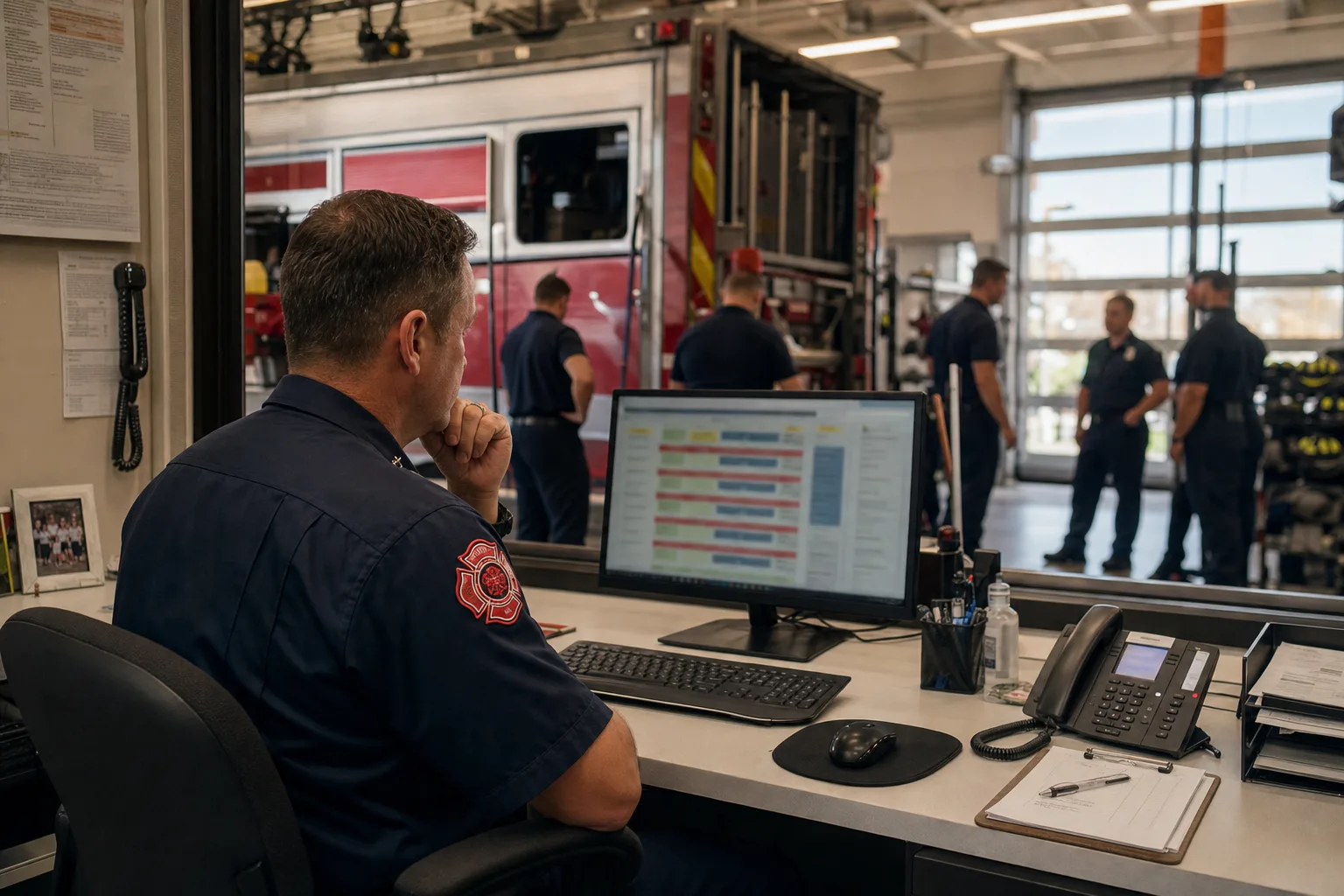
Firefighter scheduling is the process of assigning qualified personnel to stations, apparatus, and duty roles while maintaining required coverage through leave, trades, call-offs, and vacancies. A workable schedule must answer more than who is on duty. It must show whether every station or company has the required officer, driver/operator, firefighter, medic, or other qualified member.
Departments should begin with coverage requirements, choose a shift pattern that fits their staffing model, and establish consistent workflows for availability, leave, swaps, overtime, and last-minute vacancies. The schedule should also give officers a current view of scheduled staffing versus required staffing. When spreadsheets, group texts, and paper forms can no longer provide that control, a dedicated firefighter scheduling system becomes an operational tool rather than an administrative convenience.
Build the Schedule Around Coverage, Not the Calendar
A repeating calendar is only the foundation. The operational schedule must account for four connected elements:
- Demand: Stations, apparatus, or duty functions that must be staffed.
- People: Career, part-time, paid-on-call, or volunteer members available for assignment.
- Qualifications: The roles each person is authorized to fill.
- Exceptions: Leave, training, trades, call-offs, vacancies, callbacks, and special events.
Start by documenting coverage requirements for each station and shift. These may include an overall department minimum, apparatus-level minimums, and role requirements. For example, nine firefighters scheduled across two stations may still be inadequate if the only qualified driver/operator is assigned away from the first-due engine.
Coverage rules should be explicit enough that a captain or scheduler can determine whether a proposed assignment is acceptable without relying on institutional memory. The guide to setting minimum staffing levels provides a more detailed framework for defining those rules.
Safety and authority verification: Staffing levels, riding assignments, apparatus qualifications, and response configurations must be established or approved by the department’s applicable fire chief, governing authority, standard operating procedures, mutual-aid agreements, and safety authority. Do not treat a scheduling template as an operational risk assessment.
Compare Common Fire Department Shift Patterns
The right pattern depends on call volume, staffing numbers, station workload, labor agreements, fatigue controls, training needs, and the type of department. No pattern is automatically suitable for every organization.
| Pattern or model | Typical structure | Operational questions to resolve |
|---|---|---|
| 24/48 | One 24-hour shift followed by 48 hours off, often using A/B/C crews | How will leave, scheduled work hours, overtime, and fatigue after busy nights be handled? |
| 48/96 | Two consecutive 24-hour shifts followed by 96 hours off | Are call volume, sleep interruption, commute patterns, and fatigue controls compatible with 48-hour tours? |
| Modified rotation | A repeating cycle with 10-, 12-, 14-, or 24-hour shift types | Can members and officers easily understand the rotation, pay periods, and relief times? |
| Kelly-day schedule | A rotation that periodically schedules a member off to adjust average work hours | How are Kelly days assigned, backfilled, traded, and shown separately from leave? |
| Duty-crew model | Members commit to specific station or response periods | What is the minimum crew, and when does a commitment become an approved assignment? |
| Availability or on-call model | Volunteers or part-time members submit periods when they can respond | Does availability indicate intent only, or does an officer convert it into a scheduled duty assignment? |
| Hybrid combination model | Career baseline staffing supplemented by part-time or volunteer coverage | Which positions can supplemental members fill, and who has authority to make assignments? |
A/B/C crew labels identify recurring groups; they do not by themselves define the work cycle. Two departments can both use A, B, and C crews while using different start times, relief days, or overtime rules.
Evaluate patterns over a full rotation rather than looking at a single week. The review should include weekends, holidays, training days, common leave periods, and the transition between payroll cycles. Departments developing continuous coverage can use this 24/7 coverage scheduling guide to examine the underlying rotation choices.
Translate Minimum Staffing Into Assignable Positions
A single department-wide number is rarely enough for daily scheduling. Break the requirement into positions that reflect how the department deploys resources.
For each shift, define:
- The stations or locations that require coverage.
- The apparatus or functions that must remain in service.
- The minimum personnel assigned to each unit or station.
- Required roles, such as company officer, driver/operator, paramedic, EMT, or acting officer.
- Qualifications that can or cannot be combined in one person.
- Conditions under which personnel may move between stations.
- The officer authorized to approve an exception or place a unit out of service.
Consider an engine requiring one officer, one qualified driver/operator, and one firefighter. A paramedic engine may also require at least one assigned paramedic. One person might satisfy both the officer and paramedic requirements if department policy permits, but that does not reduce the engine’s total riding minimum. Scheduling rules must distinguish a qualification requirement from a headcount requirement.
Use a scheduled-versus-required view for every operational period. A useful status display should identify whether a shift is:
- Fully staffed and qualified.
- At minimum with no reserve capacity.
- Below headcount.
- Missing a required qualification.
- Dependent on an unapproved trade, tentative availability, or unfilled open shift.
This makes an uncovered position visible before the duty officer discovers it at shift change. Departments facing recurring gaps should investigate the causes rather than repeatedly treating every vacancy as an isolated event. See the guidance on handling understaffing for a structured response.
Establish One Workflow for Schedule Changes
Scheduling becomes unreliable when leave is on a paper form, trades are in text messages, and overtime assignments are kept in a separate spreadsheet. Every change should move through a defined request, review, approval, assignment, and notification process.
Availability
Availability indicates when a member can potentially work or serve. It is not necessarily a confirmed assignment. This distinction is especially important for volunteer, paid-on-call, part-time, and combination staffing.
Define:
- How far ahead members submit availability.
- Whether availability recurs or applies to specific dates.
- When officers convert availability into assignments.
- Whether members can change availability after publication.
- How late changes are communicated.
Keep unavailable, available, requested, approved, and assigned statuses distinct. Combining them creates false confidence in coverage. More detail is available in the guide to employee availability management.
Leave and planned absences
Leave workflows should identify the requested shift, affected assignment, approval authority, and coverage consequence. Before approving leave, the reviewer should see whether the absence creates a headcount or qualification gap.
A fair process also needs rules for overlapping requests, holidays, deadlines, partial-shift leave, mandatory training, court appearances, military leave, and other department-recognized absences. The scheduling system can administer these rules, but department policy must define them.
Shift trades and swaps
A trade should not become effective solely because two firefighters agreed by text. The review should confirm that:
- Both members accepted the exact dates and hours.
- The replacement is qualified for the station, apparatus, and role.
- Neither shift falls below minimum staffing.
- Work-hour, rest, overtime, and contract rules were checked.
- An authorized officer approved the change.
- The official roster and both members were updated.
A one-way coverage arrangement and a reciprocal trade may have different payroll or contract treatment. Define the terms rather than using swap for every transaction. Departments can adapt the controls in this shift-swap policy guide.
Call-offs and open shifts
A call-off is a short-notice notice that a scheduled member cannot report. The response should follow a preassigned escalation path instead of starting with an improvised group text.
- Record the absent member, assignment, time reported, and expected duration.
- Identify the exact uncovered position and required qualifications.
- Determine whether reassignment can resolve the gap without creating another one.
- Notify the eligible pool under the department’s callback or overtime procedure.
- Record offers, responses, approvals, and the final assignment.
- Notify the duty officer and affected station.
- Update the roster so personnel see one current schedule.
An open shift is an unfilled assignment offered to eligible members. Eligibility should reflect qualifications and policy, not simply who responds first, unless department rules specifically use that method. The last-minute call-outs policy guide covers escalation and documentation in more depth.
Control Overtime Without Separating It From Coverage
Overtime is a staffing consequence, not a standalone payroll exercise. The scheduler needs to know why overtime was required, which position it covered, who was eligible, and how the assignment was awarded.
Departments commonly use voluntary sign-up lists, rotating callback lists, equalization methods, holdovers, or mandatory assignments. A holdover keeps an on-duty member beyond the scheduled relief time. A callback brings an off-duty member back for an assignment. Each method requires clear authority, notification, acceptance, and documentation rules.
Track at least the vacancy, qualification needed, offer order, responses, assigned member, approving officer, and scheduled hours. If timekeeping is separate, reconcile approved schedule changes before payroll closes.
FLSA, labor, and union-contract verification: Fire-protection work periods, overtime calculations, trade treatment, callback guarantees, holdovers, leave use, and mandatory assignment rules may be affected by the Fair Labor Standards Act, state or local law, collective bargaining agreements, civil-service rules, and department policy. Departments must verify requirements with their own counsel, labor authority, payroll specialist, and applicable bargaining agreement. Scheduling software should not be treated as legal or payroll advice. Departments reviewing notice requirements should also consult this predictive scheduling laws overview and verify whether any rule applies to their jurisdiction and workforce.
Account for Career, Combination, and Volunteer Operations
Career departments often begin with fixed platoons and then manage leave, overtime, acting assignments, transfers, and relief positions. Combination departments must show how career baseline coverage and supplemental staffing interact without double-counting availability. Volunteer departments may need to turn member availability into duty crews while preserving a separate view of general response availability.
For any model, answer three questions:
- Is the person merely available, or formally assigned?
- What role is the person qualified and authorized to fill?
- Who confirms that the resulting crew meets the department’s coverage requirement?
Multi-station departments should also control transfers. Moving a qualified officer or medic may repair one station while creating a deficiency at another. Review the full system after every reassignment, not just the receiving company.
Decide When Dedicated Scheduling Software Is Necessary
Spreadsheets can work for a small, stable roster when one person manages a simple rotation and exceptions are rare. They become risky when the department cannot reliably determine which version is current or whether changes preserve qualified coverage.
Consider replacing manual processes when several of these conditions are present:
- Multiple stations, shift types, or staffing groups use the same roster.
- Officers repeatedly reconcile paper forms, email, texts, and spreadsheets.
- Members cannot see whether a trade or leave request was approved.
- Open shifts are offered manually to people who may not be qualified.
- The department discovers staffing or qualification gaps near shift change.
- Overtime offers and refusals are difficult to reconstruct.
- Volunteer availability is mistaken for confirmed duty coverage.
- Schedule changes do not consistently reach affected members.
- Payroll staff must interpret informal schedule notes.
- Only one administrator understands how the scheduling workbook functions.
A dedicated firefighter scheduling layer should support custom rotations and shift types, approval-based swaps, open shifts, qualification-based eligibility, availability, time-off requests, crew assignments, notifications, and scheduled-versus-required coverage analysis. Optional timekeeping may reduce reentry, but the department must still establish payroll controls.
Keep system boundaries clear. A scheduling platform does not replace an RMS, incident reporting system, CAD or dispatch tool, paging system, asset system, or certification-expiry tracker. Define which system owns personnel records, qualifications, incident activity, time worked, and payroll results before implementation.
Implementation Checklist
Use this checklist before publishing the first production schedule:
- Document every shift type, start time, end time, and rotation.
- Define minimum staffing by station, apparatus, and required role.
- Validate officer, driver/operator, EMS, and specialty qualifications.
- Separate availability from approved assignments.
- Configure leave, trade, open-shift, callback, and call-off workflows.
- Assign approval authority by rank or administrative role.
- Establish notification and acknowledgment expectations.
- Test holidays, partial shifts, transfers, training, and multi-day absences.
- Run the old and new process in parallel for a defined validation period.
- Reconcile scheduled hours with timekeeping and payroll procedures.
- Train members, company officers, chief officers, and schedulers by role.
- Set a process for correcting qualifications and roster errors.
- Verify FLSA, labor, union-contract, payroll, and safety requirements with the appropriate authority.
Do not automate an undefined policy. First document how a request should be handled, who decides, and what makes an assignment eligible. Then configure the workflow to enforce that decision path.
Review the Schedule as an Operational System
After implementation, review recurring vacancies, overtime causes, qualification shortages, late call-offs, unfilled open shifts, and leave patterns. These are planning indicators, not just administrative totals. For example, repeated driver/operator shortages on one crew may point to a training or crew-distribution issue rather than a lack of total personnel.
The objective is a schedule that officers can act on: one current roster, visible coverage requirements, qualified assignments, controlled changes, and documented approvals. That structure supports daily station operations while giving chiefs and administrators a clearer basis for staffing decisions.
Frequently Asked Questions
- What information should a firefighter schedule include?
- It should show the date and shift, station, apparatus or duty function, assigned members, roles, required qualifications, approved leave, open positions, and whether scheduled staffing meets the department’s coverage requirements.
- How should a department choose between 24/48 and 48/96 schedules?
- Compare each pattern against call volume, nighttime workload, fatigue controls, staffing levels, training needs, commute effects, leave coverage, labor agreements, and payroll rules. The department should evaluate a complete rotation and verify safety, FLSA, labor, and union-contract implications with its own authorities.
- Is volunteer availability the same as being scheduled?
- Not necessarily. Availability usually means a member can potentially serve during a period. A scheduled assignment means the department has placed that member on a duty crew or position and confirmed the assignment under its approval process.
- When should a fire department replace scheduling spreadsheets?
- Replacement should be considered when multiple versions circulate, approvals are difficult to track, qualification gaps are found late, open shifts require extensive messaging, overtime records are incomplete, or several stations and staffing groups must be coordinated.
- Can scheduling software determine whether staffing is legally compliant?
- No. Software can compare assignments with department-configured rules, but it cannot determine legal compliance. Departments must verify FLSA, state and local law, collective bargaining, civil-service, payroll, and safety requirements with their own counsel and applicable authorities.
Ready to replace the spreadsheet and group text?
Build the rotation, publish shifts, and see qualified coverage in ShiftSynch.
Start free