How Many Hours Do Firefighters Work? Shift Schedules Explained
Learn how 24-hour tours, 48/96 rotations, Kelly days, and volunteer duty crews shape firefighter hours, overtime, leave, fatigue, and coverage.
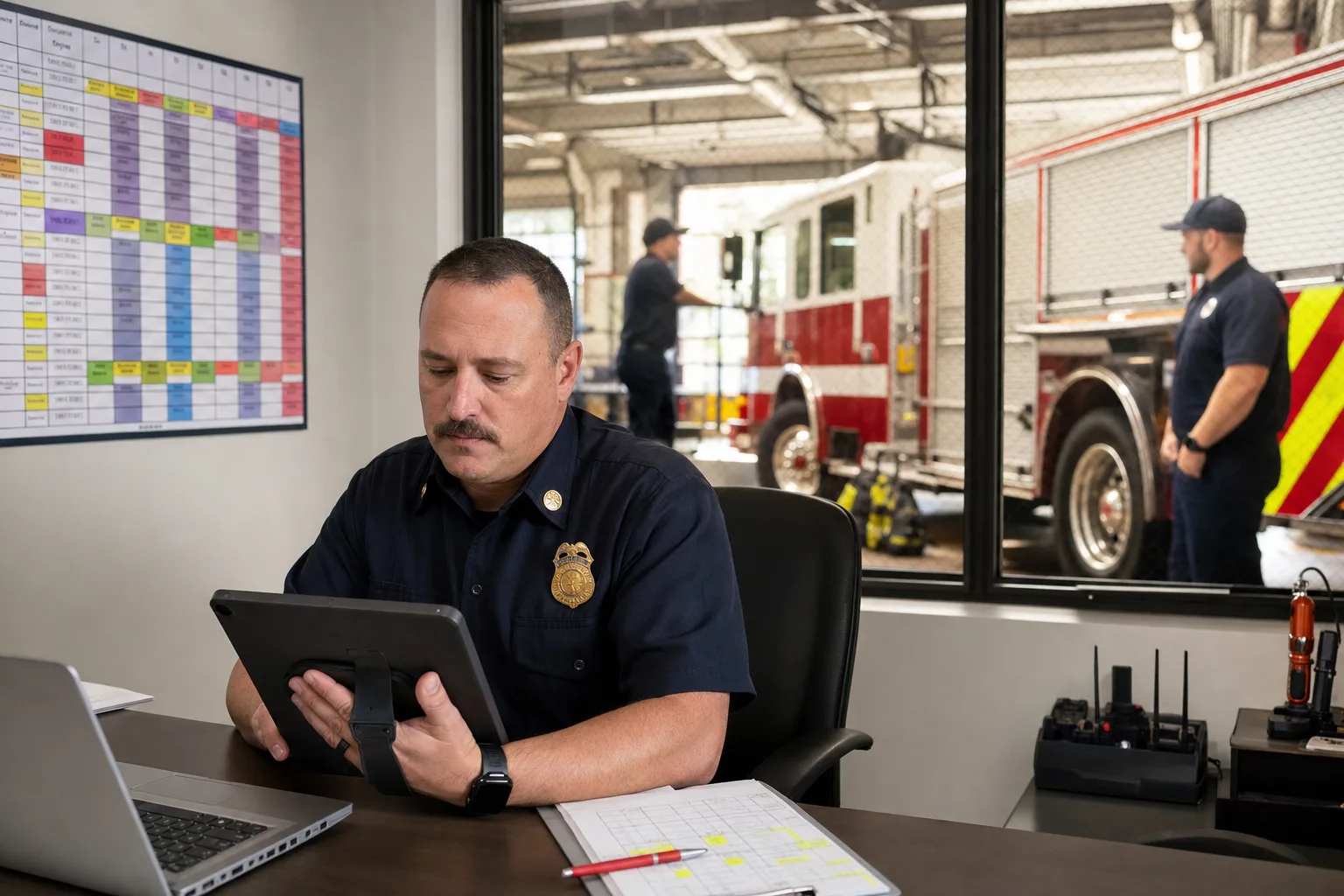
Firefighters commonly work 24-hour or 48-hour tours, but tour length is not the same as the average workweek. A 24/48 schedule assigns 24 hours on duty followed by 48 hours off, averaging 56 scheduled hours per week across its cycle. A 48/96 rotation has the same average but groups the duty time differently. A 24/72 rotation averages 42 hours per week. Kelly days can reduce the average for firefighters on longer schedules. Volunteer hours vary widely because members may cover duty crews, scheduled station shifts, on-call periods, incidents, training, or combinations of these.
For department leaders, the better question is not only how many hours firefighters work. It is whether each schedule reliably fills officer, driver/operator, firefighter, and medic positions while accounting for overtime, leave, training, fatigue, and call-offs.
Tour length, scheduled hours, and paid hours are different
A tour is one continuous period assigned on the roster, such as a 24-hour shift. Scheduled hours are the total hours assigned over the complete rotation. Paid or compensable hours may differ because of overtime rules, sleep periods, meal periods, callbacks, holdovers, training, and department policy.
Keep these measures separate:
- Tour length: How long a firefighter remains assigned, such as 12, 24, or 48 hours.
- Rotation: The repeating sequence of work and off-duty periods.
- Average scheduled workweek: Total scheduled hours in the cycle divided by the number of weeks in that cycle.
- Actual hours worked: Scheduled hours plus overtime, callbacks, holdovers, extra duty, and other worked time.
- Compensable hours: Hours the department must pay under applicable law, policy, and labor agreements.
A firefighter can therefore be assigned a 56-hour average schedule but work substantially more during a vacancy, academy assignment, major incident, or period of heavy leave.
Common firefighter shift schedules
The averages below describe the base rotation before Kelly days, overtime, leave, callbacks, or local adjustments.
| Schedule pattern | Basic rotation | Average scheduled hours | Primary operational consideration |
|---|---|---|---|
| 24/48 | 24 hours on, 48 hours off | 56 per week | Simple three-platoon rotation, but leave or vacancies can create frequent 24-hour overtime assignments |
| 48/96 | 48 hours on, 96 hours off | 56 per week | Fewer shift changes, but two consecutive duty days can increase fatigue exposure in busy systems |
| 24/72 | 24 hours on, 72 hours off | 42 per week | Requires four platoons or another coverage arrangement instead of three |
| 12-hour rotation | Day and night tours arranged in a repeating cycle | Often 42 per week, depending on the cycle | More handoffs and commute events, but shorter continuous duty periods |
| 10/14 rotation | Commonly two 10-hour day tours, two 14-hour night tours, then four days off | 42 per week | Day and night staffing must align at each changeover |
| Volunteer duty crew | Members commit to specified station or response periods | No universal average | Coverage depends on availability, turnout expectations, qualifications, and local response design |
24/48 schedules
A 24/48 rotation normally uses A, B, and C crews. Each crew works every third day. Over a repeating three-week period, a member receives seven 24-hour assignments, totaling 168 hours, or a 56-hour weekly average.
That arithmetic does not establish how overtime must be paid. It only describes scheduled time. Departments also need rules for vacancies, callbacks, mandatory holdovers, training outside the normal tour, and leave replacement.
48/96 schedules
A 48/96 rotation also uses three crews and averages 56 scheduled hours per week. Its distinguishing feature is the grouping of two 24-hour periods into one 48-hour tour, followed by four days off.
The schedule can reduce the number of shift changes and commutes. However, leaders should examine incident volume, nighttime interruptions, station workload, transport activity, and opportunities for rest. A 48-hour tour at a low-activity station presents a different fatigue profile from the same tour at a continuously busy station.
24/72 and four-platoon schedules
A 24/72 rotation typically uses four platoons and averages 42 scheduled hours per week. Moving from three to four platoons changes more than the calendar. The department must determine whether it has enough personnel in every required qualification group to build the additional crew.
For example, total headcount may appear sufficient while one platoon lacks an acting officer, driver/operator, or paramedic. Review minimum staffing levels by position, station, apparatus, and qualification rather than relying only on department-wide totals.
12-hour and 10/14 patterns
Shorter tours may be useful for dispatch, prevention, peak-demand units, wildland modules, EMS units, or departments that do not use a traditional three-platoon model. The rotation must still cover all 168 hours in a week.
More frequent shift changes create additional handoffs. Departments should define who is responsible for apparatus checks, controlled-medication counts where applicable, station duties, and unresolved operational information at each changeover.
How Kelly days change firefighter hours
A Kelly day is a scheduled day off inserted into a longer-hour rotation at a defined interval. Departments commonly use Kelly days to reduce scheduled hours, control overtime exposure, or meet a locally selected work schedule.
The effect depends on frequency. A Kelly day every cycle has a different result from one every several cycles. Do not describe a schedule as simply 24/48 with Kelly days without documenting:
- How often the Kelly day occurs
- Whether it is fixed, rotating, selected, or assigned
- How holiday and leave rules interact with it
- What happens when training or an emergency callback falls on it
- Whether the day can be moved or exchanged
- How it affects staffing on each crew
Poorly balanced Kelly-day groups can repeatedly leave one shift short in a critical qualification. Plot Kelly days against scheduled leave, academy assignments, and known vacancies before finalizing the annual roster.
Converting hours into staffing requirements
One continuously staffed position requires 168 position-hours each week. On paper, three firefighters averaging 56 scheduled hours can cover those 168 hours. That is only the base rotation: 168 divided by 56 equals three.
Three people are rarely enough to protect one position from every absence. Vacation, sick leave, injury leave, military leave, training, court appearances, vacancies, and qualification restrictions all reduce usable coverage. A department needs a relief strategy in addition to its platoon structure.
For each station and apparatus, identify:
- The minimum number of people required.
- The positions that must be filled, such as company officer or driver/operator.
- Required credentials, such as paramedic qualification.
- Personnel available to cover planned leave.
- The order for filling an unexpected vacancy.
- The point at which an apparatus is browned out, cross-staffed, or placed out of service under local authority.
A scheduled-versus-required view is more useful than a simple headcount. A crew of four does not satisfy a four-person engine requirement if nobody is authorized to drive or serve as the officer. Departments planning continuous station coverage can use this broader 24/7 coverage scheduling framework.
Overtime and FLSA questions
FLSA and legal issue to verify: Fire-protection employees may be covered by special work-period provisions under the Fair Labor Standards Act rather than a standard 40-hour workweek calculation. Eligibility, work-period adoption, overtime thresholds, partial exemptions, compensable time, and employee classifications depend on the facts and applicable law. Departments must verify their approach with qualified counsel or the authority responsible for wage-and-hour compliance.
The roster should preserve the information payroll needs without treating schedule labels as payroll conclusions. Track at least:
- Base tours and Kelly days
- Approved overtime and holdovers
- Callbacks and emergency extensions
- Training outside the normal tour
- Shift exchanges and who actually worked
- Leave type and duration
- Work-period boundaries used by payroll
Labor and union-contract issue to verify: Collective bargaining agreements, memoranda of understanding, civil-service rules, and department policies may govern overtime order, mandatory assignments, callback minimums, acting pay, trade-time treatment, and limits on consecutive hours. Verify each rule with the applicable agreement and labor authority.
Shift swaps are a common failure point. If officers approve trades through text messages but the official roster remains unchanged, staffing and payroll records can diverge. A written shift-swap policy should define eligibility, approvals, qualification matching, deadlines, and responsibility if the replacement member later calls off.
Leave and last-minute vacancies
Leave administration must connect entitlement decisions with operational coverage. Approving a vacation request is separate from determining how the vacant officer, driver, firefighter, or medic position will be filled.
A practical sequence is:
- Check scheduled staffing against the required complement.
- Identify the exact position and qualifications becoming vacant.
- Offer the opening to the eligible pool under policy or contract rules.
- Escalate through callbacks, holdovers, or mandatory assignment if authorized.
- Document any apparatus or station adjustment.
- Update the live roster and notify affected members.
For unplanned absences, establish a last-minute call-out policy before the phone rings. The policy should identify who receives the call, how the vacancy is entered, who has authority to fill it, and when command staff must be notified. Broader options for handling understaffing should account for qualifications and station geography, not merely the next available name.
Fatigue and consecutive duty time
Tour length alone does not determine fatigue risk. Incident frequency, interrupted sleep, overtime before or after the tour, commute time, training workload, secondary employment, and station assignment all matter.
A firefighter finishing a quiet 24-hour tour may have a different readiness profile from a member completing repeated nighttime calls and then accepting a holdover. The schedule should make consecutive hours and short turnarounds visible to the approving officer.
Safety issue to verify: Departments should establish fatigue and fitness-for-duty practices with their medical direction, safety committee, governing authority, labor representatives, and applicable standards in mind. Do not assume that a schedule commonly used elsewhere is automatically appropriate for local call volume or working conditions.
Useful controls can include supervisory review of extended tours, limits established by local policy, relief procedures after major incidents, and a process for declining or reassigning work when a member cannot safely perform it.
Volunteer and combination department hours
Volunteer firefighters do not share one standard workweek. A member may respond from home, staff a station duty crew, cover an overnight bunk-in period, sign up for weekend apparatus coverage, attend weekly training, or combine several arrangements.
Combination departments must also distinguish career platoon coverage from volunteer availability. Listing 20 volunteers as available does not mean the department has an officer, driver, and interior-qualified crew ready at the same station and time.
Build volunteer schedules around commitment windows and capabilities:
- Record when each member can serve, not only general membership status.
- Separate station duty from on-call or response-from-home availability.
- Match members to officer, driver, EMS, and operational qualifications.
- Identify gaps by station, apparatus, and time of day.
- Confirm duty crews before the coverage period begins.
- Define how cancellations and no-shows are reported.
Availability changes should flow into the roster through a consistent employee availability management process. Compensation, volunteer classification, on-call time, and stipend treatment are FLSA and legal issues departments must verify with their own counsel or responsible authority.
Schedule implementation checklist
Before adopting or revising a firefighter schedule, confirm the following:
- The full rotation has been mapped, including leap days and rotation transitions.
- Average scheduled hours were calculated over the complete cycle.
- Minimum staffing is defined by station, apparatus, position, and qualification.
- Kelly days and other relief days are distributed without creating predictable gaps.
- Vacation, sick leave, training, vacancies, and long-term absences are modeled.
- Overtime, callback, holdover, and mandatory-assignment rules are documented.
- Shift swaps require approval and qualification matching.
- Officers can see actual consecutive duty hours before approving extra work.
- Volunteer availability is distinguished from confirmed duty-crew assignments.
- Payroll receives who actually worked, not only the original schedule.
- FLSA, state law, labor agreements, and local policy have been reviewed by the proper authority.
- The department has tested call-off and notification procedures for nights, weekends, and holidays.
A scheduling pattern is operationally sound only when it covers required seats with qualified people and provides a workable response to leave, vacancies, overtime, and fatigue. The calendar name—24/48, 48/96, 24/72, or another pattern—is only the starting point.
Frequently Asked Questions
- How many hours do firefighters work per week on a 24/48 schedule?
- A standard 24/48 rotation averages 56 scheduled hours per week across its full cycle. Actual hours may be higher because of overtime, callbacks, holdovers, or training, and may be lower when Kelly days are built into the schedule.
- Does a 48/96 schedule mean firefighters work more hours?
- Not compared with a standard 24/48 rotation. Both average 56 scheduled hours per week. The 48/96 schedule groups two duty days together and provides four days off, changing tour length and fatigue considerations rather than the base average.
- What is a Kelly day in a firefighter schedule?
- A Kelly day is a scheduled relief day inserted at a defined interval to reduce a firefighter's average scheduled hours or support a local staffing arrangement. Its exact frequency and treatment depend on department policy, labor agreements, and the selected rotation.
- Are firefighters paid overtime after 40 hours?
- Not necessarily. Fire-protection employees may be subject to special FLSA work-period provisions, and state law or labor agreements may add other requirements. Departments must verify overtime thresholds, classifications, compensable time, and work-period rules with qualified counsel or the responsible authority.
Ready to replace the spreadsheet and group text?
Build the rotation, publish shifts, and see qualified coverage in ShiftSynch.
Start free