How Long Do Firefighters Work? Shifts and Weekly Hours
Learn common firefighter shift lengths, weekly-hour averages, Kelly days, overtime, relief coverage, and career, combination, and volunteer staffing.
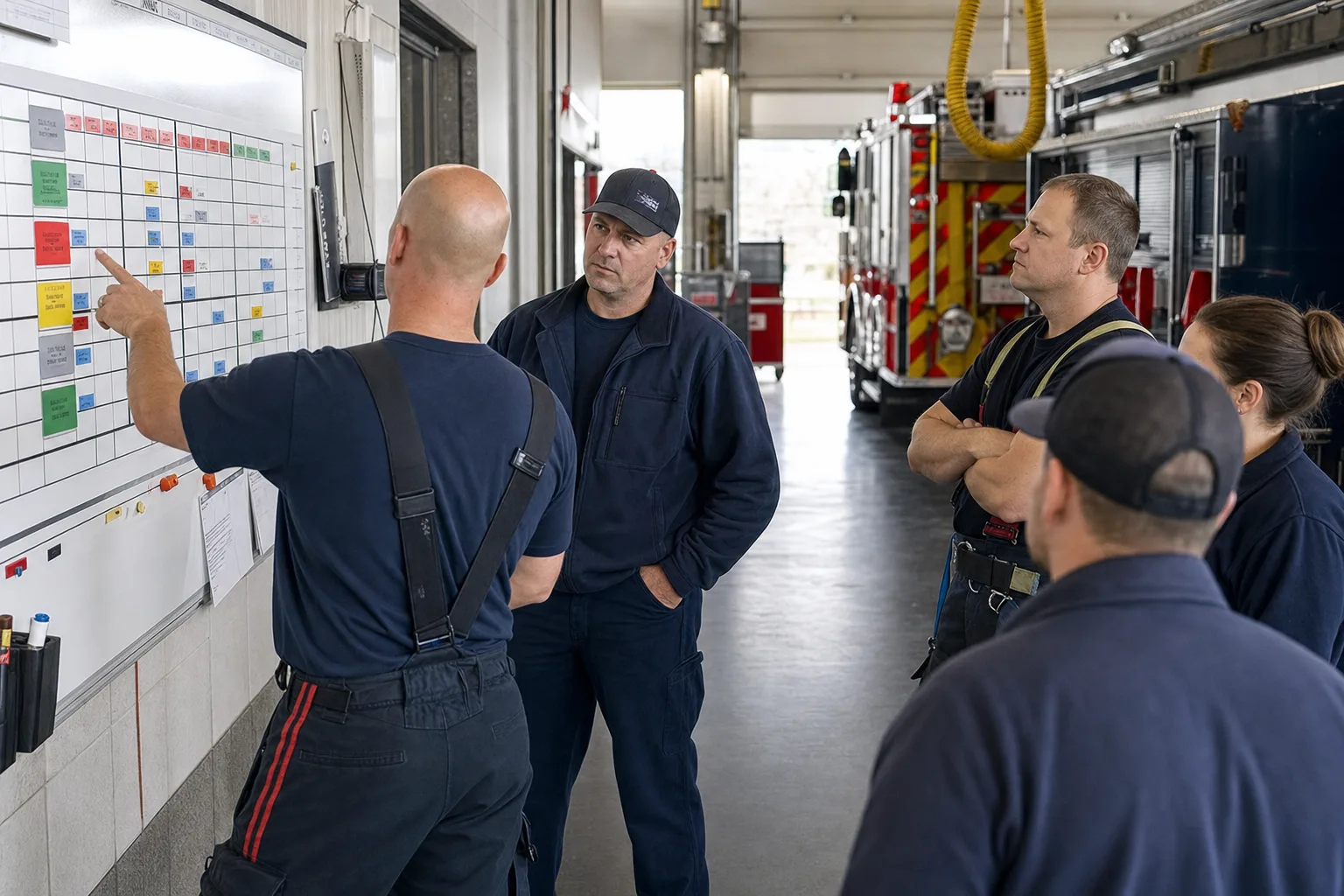
Firefighters commonly work 24-hour shifts, but shift length and weekly hours vary by department. A 24-hours-on, 48-hours-off rotation averages 56 scheduled hours per week. A 48/96 rotation has the same average, while a 24/72 rotation averages 42 hours. Other departments use 10- or 14-hour shifts, 12-hour shifts, weekday staffing, or volunteer duty crews.
Those figures describe scheduled hours, not necessarily overtime, callback hours, training, shift trades, or time worked after a call-off. Kelly days, labor agreements, staffing minimums, and applicable wage-and-hour rules can change how many hours firefighters are scheduled or paid. For a related breakdown, see how many hours firefighters work.
Common firefighter shift lengths and rotations
Structural fire protection requires coverage at night, on weekends, and during holidays. Many career departments divide personnel into A, B, and C crews or platoons that rotate through around-the-clock duty. Departments may use more than three crews, separate schedules for different divisions, or day staffing for administrative and support assignments.
The table shows common patterns, not mandatory or universal schedules.
| Schedule pattern | Typical cycle | Approximate weekly average | Operational consideration |
|---|---|---|---|
| 24 on/48 off | One 24-hour shift every three days | 56 hours | Simple three-platoon rotation, but leave and call-offs can create frequent 24-hour vacancies |
| 48 on/96 off | Two consecutive duty days followed by four days off | 56 hours | Fewer commutes and handoffs, but fatigue and call volume require careful evaluation |
| 24 on/72 off | One duty day followed by three days off | 42 hours | Usually requires four platoons and a larger base roster |
| Two 10-hour days, two 14-hour nights, four off | Eight-day cycle | 42 hours | More handoffs, but no scheduled 24-hour duty period |
| Alternating 12-hour shifts | Pattern varies | Often about 42 hours | Day/night transitions and qualification coverage need close management |
| Weekday or day staffing | Often five eight-hour days | About 40 hours | Common for prevention, training, administration, or some combination-department coverage |
| Volunteer or paid-on-call duty crew | Department-defined blocks | Variable | Hours depend on availability, station-duty commitments, response expectations, and local policy |
A 24-hour shift does not mean 24 hours of continuous emergency activity. It is a duty period during which the crew remains responsible for response, apparatus checks, training, inspections, station work, meals, and permitted rest. Busy systems may have repeated nighttime responses, making fatigue a major schedule-design concern. Departments must verify fatigue controls and safe operating practices with their own medical, safety, and operational authorities.
How weekly firefighter hours are calculated
Weekly averages should be calculated across the rotation’s complete cycle rather than from a single calendar week. A useful formula is:
Average weekly hours = duty hours in the full cycle × 168 ÷ total cycle hours
For a 24/48 schedule, a firefighter works 24 hours in each 72-hour cycle. Multiplying 24 by 168 and dividing by 72 produces a 56-hour weekly average. A 48/96 schedule produces the same result because 48 of every 144 hours are scheduled duty hours.
Calendar weeks can still look uneven. One firefighter may have 72 scheduled hours between Sunday and Saturday, followed by a lighter week. Payroll calculations, contractual overtime, and federal wage-and-hour calculations may use different work periods. A department should therefore keep these concepts separate:
- Rotation average: Long-term scheduled hours produced by the shift pattern.
- Calendar-week hours: Duty hours falling within a particular seven-day calendar window.
- Work-period hours: Hours counted in the period used for applicable overtime calculations.
- Actual worked hours: Scheduled duty plus holdovers, callbacks, training, or other compensable activity, less applicable leave.
For more rotation examples, see firefighter hours and 24/7 coverage scheduling.
What Kelly days do to scheduled hours
A Kelly day is a recurring scheduled relief day placed into a firefighter’s rotation. Departments use Kelly days to reduce average scheduled hours, align a rotation with a labor agreement, or manage overtime exposure. A Kelly day is generally part of the regular schedule rather than vacation requested by the employee.
The frequency varies. For illustration, removing one 24-hour shift every three weeks reduces the mathematical average by eight hours per week during that cycle: 24 hours divided by three weeks. That example does not establish what any department should use.
Kelly-day implementation requires several choices:
- Whether each member has a fixed Kelly day or it rotates.
- Whether Kelly relief is assigned to a dedicated relief firefighter, a floater, or overtime personnel.
- How holidays, trades, transfers, and long-term leave affect the Kelly assignment.
- Whether a member can move or waive a Kelly day.
- Which record controls when the staffing calendar and payroll system disagree.
A common failure is counting the absent member’s Kelly day without planning the replacement needed to maintain apparatus staffing. The schedule may look correct at the platoon level while leaving a station without an officer, qualified driver/operator, or required medic-level member.
Labor and overtime verification: Kelly-day treatment can be affected by collective bargaining agreements, local policy, and wage-and-hour rules. Departments must verify their approach with labor counsel, payroll authorities, and the applicable union contract.
Scheduled hours are not the same as overtime
A firefighter can be scheduled for an average exceeding 40 hours without every hour over 40 automatically being treated the same way as overtime in a conventional office schedule. Fire-protection personnel may be subject to specialized federal, state, or local rules, including the federal Fair Labor Standards Act fire-protection work-period provisions commonly associated with Section 7(k).
FLSA and legal verification: Departments must have their own counsel or qualified authority determine eligibility, the valid work period, overtime thresholds, compensable activities, sleep-time treatment where applicable, substitutions, and recordkeeping. State law, local rules, and labor agreements may provide different or additional obligations.
Operationally, schedulers should distinguish among:
- Built-in scheduled hours: Hours generated by the normal rotation.
- Planned overtime: A vacancy filled in advance for leave, training, or a known detail.
- Unplanned overtime: A callback or holdover caused by a last-minute call-off or incident.
- Shift trade: Two eligible members exchange assignments under department policy.
- Extension of duty: A member remains beyond relief because an incident or late replacement prevents an on-time handoff.
An approved trade may solve coverage without changing the hours assigned to the position, but it can affect the employees’ actual work sequence and fatigue exposure. A clear shift-swap policy should address approval, qualification equivalency, repayment deadlines, maximum consecutive hours, and payroll handling.
Relief coverage determines whether a rotation works
A rotation only identifies when each platoon is due to work. It does not automatically provide enough people to cover vacation, sick leave, injury leave, training, military leave, Kelly days, or vacant positions.
Start by defining required coverage for each station, unit, and time block. A department might require an officer and driver/operator on each engine, plus a particular medical qualification somewhere on the duty crew. The exact requirements must come from the department’s adopted policy, authority having jurisdiction, labor agreement, and safety review—not from scheduling software.
After defining the requirements, compare scheduled staffing with required staffing. That comparison should identify both headcount shortages and qualification gaps. Six people scheduled for six seats is not adequate if none can fill the required officer position.
Relief options may include:
- Dedicated relief or float personnel.
- Reassignment between stations under established policy.
- Qualified part-time or paid-on-call personnel.
- Voluntary overtime, followed by mandatory overtime if authorized.
- Officer-approved shift trades.
- A unit-status or staffing contingency authorized by department leadership.
Departments should establish the order before a vacancy occurs. Guidance on defining the baseline is available in setting minimum staffing levels, while handling understaffing covers escalation options.
Safety and labor verification: Minimum staffing, forced overtime, station moves, consecutive-duty limits, and placing units out of service can involve safety standards, bargaining obligations, and local requirements. Departments must verify them with their own authority, counsel, and union contract.
Career, combination, and volunteer staffing models
Career departments
Career departments typically publish repeating platoon assignments well in advance. Their main scheduling challenge is maintaining every required seat and qualification through leave, trades, callbacks, and vacancies. Multi-station departments also need rules governing when a relief firefighter follows a position, apparatus, station, or battalion assignment.
Combination departments
Combination departments must coordinate career shifts with volunteer, paid-on-call, or part-time availability. A career crew may provide weekday station coverage while volunteers supplement evenings, weekends, second-out apparatus, or major incidents.
The schedule should show whether a volunteer’s availability is merely an indication that the member may respond or a confirmed duty-crew assignment. Treating those two statuses as equivalent can create apparent coverage that does not exist. See employee availability management for methods of separating availability from assignments.
Volunteer departments
Volunteer firefighters may not have a fixed weekly total. Some departments use scheduled station-duty blocks; others rely on response availability, rotating duty officers, or assigned overnight and weekend crews. Scheduling should reflect the department’s actual commitment model rather than forcing every member into a career-style rotation.
Volunteer schedules also need qualification logic. A full duty crew by headcount may still lack an apparatus operator, interior-qualified firefighter, officer, or medical responder required by department policy. Additional volunteer-specific guidance is available in the volunteer departments category.
Classification verification: Whether a member is an employee, volunteer, paid-on-call member, or another classification is a legal and compensation issue. Departments must verify classification, stipend, hourly-pay, overtime, and availability practices with qualified counsel and the applicable authority.
Schedule implementation checklist
Use this checklist before publishing a new rotation or materially changing an existing one:
- Map the full rotation cycle, including Kelly days and platoon transitions.
- Calculate average hours across the complete cycle.
- Define required staffing by station, apparatus, time block, and qualification.
- Separate availability, scheduled assignment, approved leave, and actual attendance.
- Estimate relief needs for recurring leave, training, vacancies, and call-offs.
- Establish the order for trades, volunteers, floaters, overtime, and station moves.
- Set approval rules for swaps and time-off requests.
- Define maximum consecutive-duty and fatigue-review triggers through the proper authority.
- Test holidays, daylight-saving changes, leap years, transfers, and long-term absences.
- Confirm payroll and timekeeping treatment with labor and legal reviewers.
- Publish one authoritative calendar and document who can edit it.
- Review scheduled-versus-required coverage before each operational period.
Last-minute absences need their own workflow rather than a chain of informal texts. A last-minute call-outs policy can define reporting deadlines, supervisor responsibilities, vacancy escalation, and documentation.
Common scheduling failure points
| Failure point | Operational effect | Better control |
|---|---|---|
| Counting people without qualifications | Apparatus appears staffed but lacks an officer, driver, or required medical capability | Match every open position to eligibility rules |
| Using separate station spreadsheets | Transfers and trades create conflicting assignments | Maintain one department-wide schedule |
| Treating availability as commitment | Volunteer or part-time coverage is overstated | Require confirmation for assigned duty blocks |
| Filling vacancies only after a call-off | Repeated holdovers and rushed callbacks | Forecast known leave and publish open shifts early |
| Allowing unreviewed trades | Qualification or consecutive-hour problems | Require officer approval and an audit trail |
| Ignoring relief in roster planning | The base rotation works only when nobody is absent | Analyze scheduled staffing against required coverage |
How centralized scheduling supports coverage
A centralized scheduling system gives officers, members, and administrators one current view of platoon assignments, open positions, approved leave, availability, and qualification-based eligibility. It should preserve the department’s rules rather than decide what staffing or overtime policy should be.
For example, a dedicated fire-department scheduling layer can manage custom A/B/C rotations, 48/96 schedules, officer-approved swaps, open-shift notifications to qualified members, crews, time-off requests, and scheduled-versus-required coverage analytics. Optional timekeeping can record actual hours, but payroll and legal treatment still require department review.
ShiftSynch provides those scheduling functions for career, combination, and volunteer departments. It is not an RMS, NFIRS or incident-reporting system, CAD or dispatch platform, paging tool, asset system, or certification-expiry tracker. Departments should define which system owns scheduling, attendance, payroll, incident records, and credential records so that each function has a clear source of truth.
The practical objective is not merely to display a repeating calendar. It is to show whether every station and apparatus assignment is covered by an eligible person, expose shortages early, and document how call-offs, relief assignments, and shift changes were resolved. See fire department scheduling software for a broader implementation framework.
Frequently Asked Questions
- How many hours do firefighters work per week?
- Many career firefighters average 42, 48, or 56 scheduled hours per week, depending on the rotation and Kelly-day pattern. A 24/48 or 48/96 rotation averages 56 hours before scheduled relief days. Actual hours can be higher because of overtime, callbacks, training, or incident-related extensions.
- Do firefighters work 24 hours straight?
- A 24-hour shift is a continuous duty period at the station, but it does not mean 24 hours of uninterrupted emergency work. The shift can include responses, training, inspections, apparatus checks, station duties, meals, and permitted rest. Call volume can substantially affect sleep and fatigue.
- Does a 48/96 schedule reduce weekly hours?
- Not by itself. A repeating schedule of 48 hours on and 96 hours off averages 56 scheduled hours per week, the same mathematical average as 24 hours on and 48 hours off. Kelly days or other scheduled relief can reduce the average.
- Are volunteer firefighters assigned regular shifts?
- Some are. Volunteer departments may use station-duty shifts, overnight crews, weekend teams, rotating duty officers, or availability-based response. The schedule should distinguish a member who is available to respond from one who has accepted a confirmed duty assignment.
- When do firefighter hours become overtime?
- That depends on the applicable FLSA work period, state and local law, collective bargaining agreement, department policy, and the type of activity performed. Departments must have qualified counsel or another appropriate authority verify overtime thresholds, compensable time, trades, callbacks, and recordkeeping.
Ready to replace the spreadsheet and group text?
Build the rotation, publish shifts, and see qualified coverage in ShiftSynch.
Start free