Firefighter Hours: Shifts, Coverage, and Overtime
Learn how firefighter hours are scheduled and calculated, including 24-hour shifts, coverage minimums, overtime, trades, call-offs, and records.
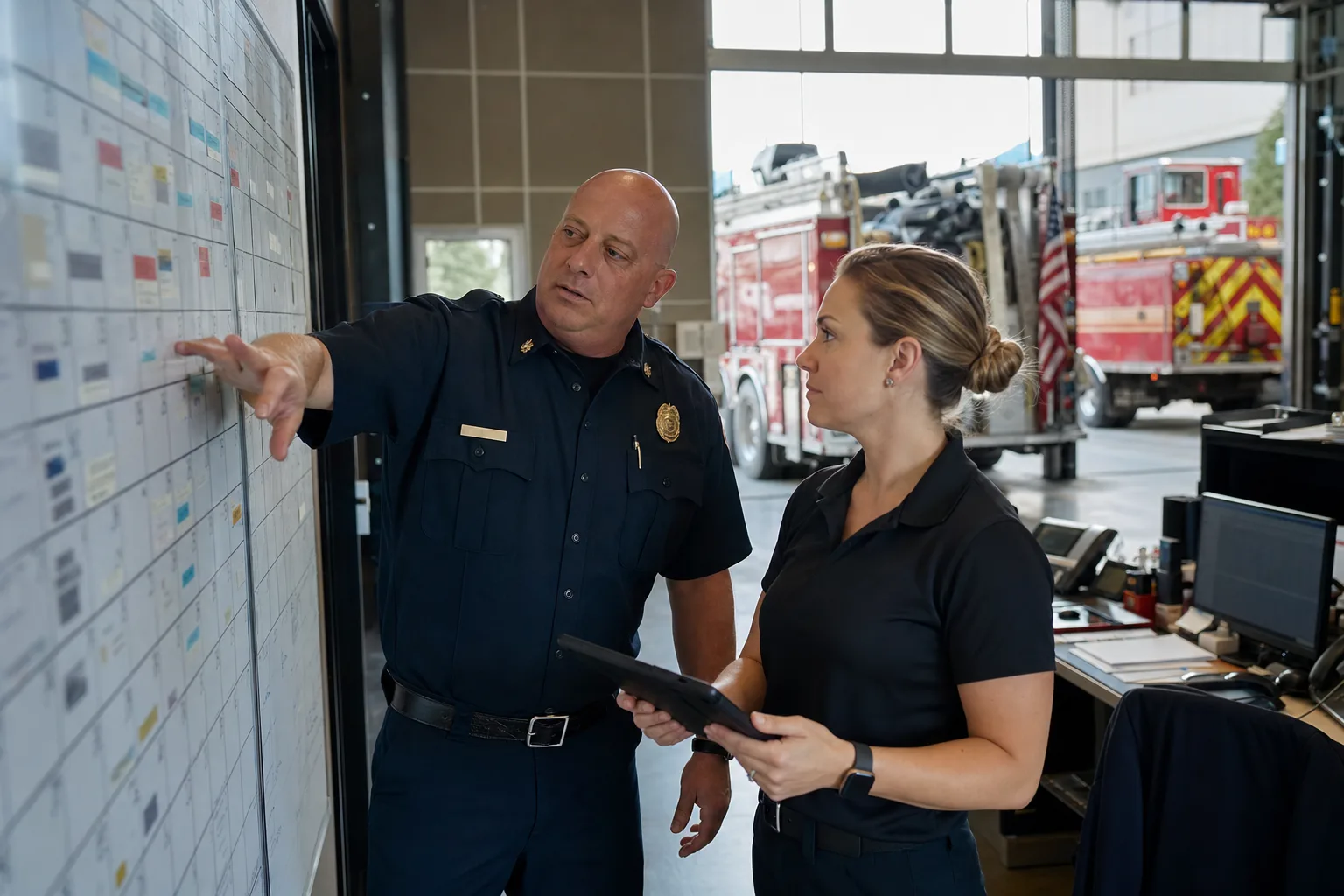
Firefighter hours depend on the department’s coverage model, shift rotation, staffing minimums, relief practices, and labor rules. Career departments may use 24-hour or longer duty shifts, while combination and volunteer departments often mix staffed shifts, duty crews, availability, and on-call response. Administrators need to distinguish scheduled hours from hours actually worked, overtime hours, leave, and shift trades. A reliable process also tracks whether each station and apparatus has the required officers, drivers, firefighters, and medical qualifications. The objective is not merely to fill calendar slots—it is to document who is expected to report, whether the assignment meets coverage requirements, and how exceptions are handled.
What “firefighter hours” can mean
The phrase can refer to several different measurements. Mixing them together creates payroll disputes, misleading staffing reports, and gaps between the schedule and actual station coverage.
- Scheduled hours: The hours assigned before leave, call-offs, holdovers, or trades are applied.
- Worked hours: Time the firefighter actually worked, including approved extensions or callbacks when applicable.
- Paid hours: Hours compensated under the department’s pay rules. These may not always match scheduled or worked hours.
- Overtime hours: Hours treated as overtime under applicable law, policy, labor agreement, or employment terms.
- Leave hours: Vacation, sick leave, compensatory time, military leave, training leave, or another approved absence category.
- Availability: Periods when a volunteer, paid-on-call member, or part-time firefighter indicates that they can accept an assignment. Availability is not automatically the same as scheduled duty.
- On-call or standby time: A defined period during which a member may have response obligations. Whether and how that time is compensated is a legal and policy question.
Departments should publish these definitions in scheduling and payroll procedures. The duty calendar should also identify the official start and relief times, especially when members arrive early for apparatus checks or remain after relief to complete a response or report.
For a broader explanation of common hour totals, see how many hours firefighters work.
Common fire department shift patterns
A shift pattern must be evaluated as a complete rotation rather than by looking at one duty day. Two schedules may both use 24-hour shifts but produce different work totals because of days off, debit days, Kelly days, training assignments, or scheduled relief days.
| Pattern or model | Basic structure | Hour-calculation issue | Operational consideration |
|---|---|---|---|
| 24 on/48 off | One 24-hour duty period followed by 48 hours off | A repeating 72-hour cycle averages 56 scheduled hours per seven days before relief-day adjustments | Requires three recurring platoons, often called A/B/C crews |
| 48 on/96 off | Two consecutive 24-hour periods followed by 96 hours off | Also averages 56 scheduled hours per seven days before adjustments | Fatigue, sleep interruption, commute, and relief practices require local safety review |
| 24 on/72 off | One 24-hour duty period followed by 72 hours off | A repeating 96-hour cycle averages 42 scheduled hours per seven days | Typically requires four platoons for continuous staffing |
| Day or night shifts | Commonly 8-, 10-, or 12-hour assignments | Weekly totals depend on the number and placement of shifts | Can support peak staffing, prevention, training, or transport units |
| Part-time blocks | Members claim or receive defined station assignments | Hours vary by member and pay period | Eligibility and maximum-hour controls may be needed |
| Volunteer duty crews | Members commit to station coverage or response periods | Scheduled duty, standby, and incident time should be recorded separately | The department needs a fallback when a duty crew is incomplete |
These are structural examples, not recommendations. Departments should assess call volume, nighttime workload, station geography, leave use, training demands, fatigue risks, and labor obligations before changing rotations. The 24/7 coverage scheduling guide and the detailed 48/96 firefighter schedule guide explain additional implementation considerations.
How to calculate scheduled firefighter hours
Start with the rotation itself, then calculate totals over its full repeating cycle.
Calculate the base rotation
Use this basic formula:
Scheduled hours in the cycle = number of duty shifts × hours per shift
To find a weekly average:
Average weekly hours = cycle hours ÷ cycle days × 7
For a 24-on/48-off rotation:
- Cycle length: 72 hours, or three days
- Scheduled duty: 24 hours
- Average: 24 ÷ 3 × 7 = 56 scheduled hours per seven days
That average does not mean every calendar week or payroll period contains exactly 56 hours. Depending on where the rotation falls, one period may contain more duty shifts than another. Annualized estimates are useful for budgeting, but payroll and attendance records should use the department’s actual defined work period and assignments.
Apply schedule adjustments
After calculating the base rotation, account for:
- Kelly days or other scheduled relief days
- Debit days added to meet an annual or contractual hour target
- Training assignments outside the normal rotation
- Temporary transfers or details
- Approved leave
- Trades and partial-shift exchanges
- Holdovers, callbacks, and mandatory overtime
- Mid-shift call-offs or early relief
Keep the original assignment, adjustment, approving officer, and final worked assignment as separate data points. Overwriting the original schedule makes it difficult to reconstruct why an overtime payment or staffing exception occurred.
Do not calculate overtime from the average alone
A 56-hour average does not by itself determine when overtime is due. Overtime can depend on the employer, employee classification, adopted work period, applicable law, labor agreement, and treatment of leave or substitutions.
FLSA and labor issue to verify: Public-agency fire-protection employees may be subject to the Fair Labor Standards Act’s Section 7(k) provisions when the legal requirements are met. Departments should have their own counsel, payroll authority, and labor representatives verify the applicable work period, overtime threshold, employee eligibility, and treatment of specific hour categories. A collective bargaining agreement or local rule may provide requirements beyond federal law.
Build hours around coverage requirements
A schedule can contain enough total firefighter hours and still fail operationally. Coverage must be measured by location, time, apparatus, role, and qualification—not only by total headcount.
For example, a department may require a station assignment to include an officer, an apparatus operator or driver, and a firefighter with the required EMS qualification. Four available members do not create a compliant crew if none is eligible to drive the assigned apparatus.
A practical coverage record should answer:
- How many positions are required at each station and time?
- Which apparatus or functions must remain staffed?
- Which positions require officer, driver/operator, paramedic, EMT, or other qualifications?
- Can one member satisfy more than one qualification requirement, and does policy allow that member to fill both roles?
- What happens when a unit is committed to training, a detail, or another station?
- Who can authorize an exception, closure, move-up, callback, or cross-staffing arrangement?
Document the difference between scheduled coverage and required coverage. A visible deficit of one qualified driver is more actionable than a general warning that the shift is short. Departments defining these rules can use the minimum staffing levels guide and the operational options in handling understaffing.
Safety and authority issue to verify: Staffing levels, apparatus deployment, qualification requirements, and fatigue controls must be established by the department’s authority having jurisdiction and reviewed against applicable safety rules, mutual-aid commitments, labor agreements, and local operating procedures.
Career, combination, and volunteer hour models
Career departments
Career departments commonly assign members to recurring platoons, stations, and positions. The main scheduling challenges are maintaining minimum staffing through leave, filling vacancies with qualified personnel, distributing overtime under policy, and reconciling the schedule with payroll.
A multi-station department should avoid treating the entire shift as one interchangeable pool. Moving a firefighter from Station 1 to Station 3 may fill headcount while leaving an officer, driver, or medic gap elsewhere. Transfers and move-ups should be shown on the final roster.
Combination departments
Combination departments must coordinate different assignment rules in the same coverage plan. Career members may work a fixed rotation, part-time members may claim open shifts, and volunteers may staff duty crews or respond from availability.
The schedule should label each person’s status and assignment type. It should also define whether part-time and volunteer members can fill the same operational positions as career members, based on department-approved qualifications and policy—not merely calendar availability.
Volunteer departments
Volunteer hours may include station duty, incident response, drills, meetings, public education, and administrative assignments. These categories should not be assumed to have identical reporting or compensation treatment.
Departments using duty crews should establish a deadline for commitments, a minimum crew composition, and an escalation process when members withdraw. Availability data can help officers identify potential replacements, but it should not be presented as a confirmed assignment until the member accepts and any required approval occurs. See employee availability management and additional volunteer department guidance.
FLSA and legal classification issue to verify: Volunteer status, stipends, on-call arrangements, and paid-on-call practices can raise wage-and-hour and worker-classification questions. Departments should verify their arrangements with qualified counsel and the appropriate government authority.
Manage overtime, trades, and call-offs consistently
Overtime assignments
An overtime process should state how an opening is created, who is eligible, how members are notified, how responses are ranked, who approves the assignment, and what happens if nobody accepts. The procedure may use rotation lists, equalization, seniority, first acceptance, mandatory assignment, or another locally approved method.
Record declined, missed, canceled, and awarded opportunities only when required by the department’s established process. Do not let informal text chains become the only evidence of how a vacancy was offered.
Shift trades
A trade changes who works; it should not quietly change required coverage. Before approval, verify that the substitute can fill the original station, apparatus, and qualification role. Partial trades also need precise start and end times.
The department should define:
- Whether trades require officer approval
- How far in advance requests must be submitted
- Whether trades across ranks or qualification levels are allowed
- Who is responsible if the substitute calls off
- How trades appear in payroll and overtime calculations
- Whether members can trade while on restricted duty or specific leave statuses
The shift-swap policy guide provides a framework for documenting these decisions.
Last-minute call-offs
A call-off process should capture the affected position, time reported, expected duration, and person notified. The supervisor can then evaluate options in sequence: use available on-duty personnel, transfer qualified staff, offer an open shift, call back personnel, use mutual-aid or deployment alternatives, or apply another authorized contingency.
Avoid filling the first available name without checking qualifications and downstream station effects. A driver transferred to cover one engine may create a new vacancy on another. Departments can formalize the escalation sequence with a last-minute call-outs policy.
Document hours with a schedule audit trail
The final schedule should be a defensible operational record, not just a planning board. Preserve:
- Original and revised assignments
- Duty date, start time, and end time
- Station, crew, apparatus, or functional position
- Required and held qualifications
- Leave and vacancy type
- Trade or open-shift request
- Approval, denial, and assignment timestamps
- Holdover, callback, and partial-shift hours
- Notes for authorized staffing exceptions
- Export or handoff status for payroll, when applicable
Access should follow job responsibilities. A firefighter may need to view assignments and request leave, while a captain approves swaps and a scheduler changes staffing requirements. Payroll personnel may need hour totals without authority to change operational qualifications.
Scheduling software should support the department’s rules rather than replace them. Useful capabilities include custom rotations, crews, availability, officer-approved swaps, qualification-based eligibility, open-shift notifications, time-off workflows, and scheduled-versus-required coverage reporting. ShiftSynch provides these scheduling functions with optional timekeeping, but it is not CAD, paging, RMS, incident reporting, asset management, or a certification-expiry tracker. Those boundaries matter when defining the department’s system of record. See fire department scheduling software for evaluation criteria.
Firefighter-hours implementation checklist
Use this checklist when establishing a schedule or correcting an inconsistent process:
- Define scheduled, worked, paid, overtime, leave, standby, and availability hours.
- Document each rotation’s full cycle, relief time, and payroll work period.
- Calculate base hours over the full rotation rather than one calendar week.
- Identify minimum staffing by station, apparatus, time, and qualification.
- Configure A/B/C crews, duty crews, part-time pools, and relief assignments separately.
- Establish approval rules for leave, swaps, open shifts, callbacks, and holdovers.
- Define the order used to resolve a vacancy and who can authorize exceptions.
- Preserve original assignments and all subsequent changes.
- Reconcile the operational roster with timekeeping or payroll records.
- Review unresolved qualification gaps before each shift begins.
- Test call-off procedures for nights, weekends, and unavailable supervisors.
- Train members and officers on one official method for requests and approvals.
- Have counsel or the appropriate authority verify FLSA, labor, contract, classification, and predictive-scheduling issues.
- Review fatigue and safety implications through the department’s authorized safety process.
Common failure points include using headcount as the only coverage measure, allowing unapproved swaps, treating availability as acceptance, editing past schedules without an audit trail, and assuming the rotation average is the overtime threshold. A disciplined hour record connects every person and time block to a real operational assignment while leaving legal, labor, and safety determinations with the authorities responsible for them.
Frequently Asked Questions
- How many hours do firefighters work in a week?
- The total depends on the rotation. A repeating 24-on/48-off or 48-on/96-off pattern averages 56 scheduled hours per seven days before Kelly days or other adjustments. Actual calendar weeks and payroll periods can contain different totals.
- Do firefighter shift trades count as overtime?
- Not automatically. The treatment of a trade depends on applicable wage-and-hour rules, the employer’s adopted work period, department policy, and any labor agreement. Departments should have counsel, payroll staff, and labor representatives verify the correct treatment.
- How should a department calculate coverage for a shift?
- Compare scheduled staffing with requirements by station, apparatus, time, position, and qualification. Total headcount is insufficient when the roster lacks a required officer, driver/operator, medic, or other qualified member.
- What is the difference between availability and a scheduled shift?
- Availability indicates that a member may be able to work. A scheduled shift is a confirmed assignment with defined times, location, role, and any required approval. Volunteer and part-time departments should keep these statuses separate.
- Can scheduling software calculate firefighter overtime?
- Software can organize assigned and worked hours and support timekeeping, but the department must first define its legal and contractual rules. FLSA eligibility, work periods, overtime thresholds, leave treatment, and union requirements should be verified with the appropriate counsel or authority.
Ready to replace the spreadsheet and group text?
Build the rotation, publish shifts, and see qualified coverage in ShiftSynch.
Start free