24 72 Firefighter Schedule: Rotation and Staffing Guide
Learn how a 24-on, 72-off firefighter rotation affects crew cycles, minimum staffing, leave, trades, overtime, and vacancy coverage decisions.
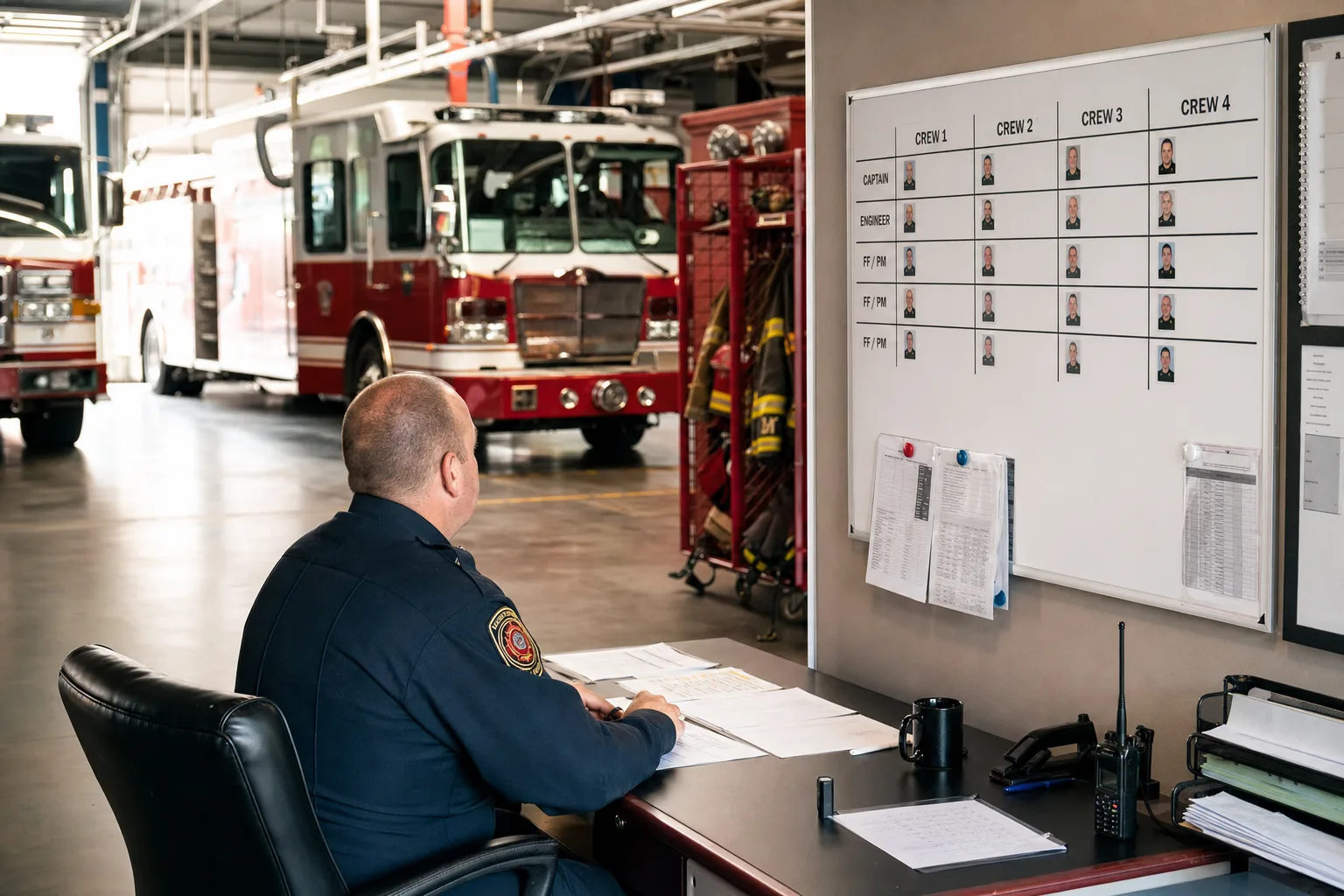
A 24 72 firefighter schedule assigns a member or crew to 24 consecutive hours on duty followed by 72 hours off. Continuous station coverage normally requires four platoons—often A, B, C, and D—working successive 24-hour tours. Each platoon returns every fourth day, averaging 42 scheduled hours per week over the full rotation.
The rotation is simple on paper. The operational challenge is keeping every station, apparatus, and required position covered when members take leave, trade shifts, attend training, or call off. Departments need rules for qualification-based assignments, minimum staffing, overtime, approvals, and schedule changes. A centralized schedule can generate the rotation, identify vacancies, restrict replacements to eligible members, and preserve an auditable record of who is assigned.
How the 24-on, 72-off rotation works
A tour is one continuous duty period. Under this rotation, each tour lasts 24 hours and begins at a department-defined changeover time, such as 0700 or 0800. The next platoon relieves the on-duty platoon at the same time the following day.
A basic four-platoon sequence looks like this:
| Day | On-duty platoon | A platoon status | B platoon status | C platoon status | D platoon status |
|---|---|---|---|---|---|
| Monday | A | On duty | Off | Off | Off |
| Tuesday | B | Off | On duty | Off | Off |
| Wednesday | C | Off | Off | On duty | Off |
| Thursday | D | Off | Off | Off | On duty |
| Friday | A | On duty | Off | Off | Off |
| Saturday | B | Off | On duty | Off | Off |
| Sunday | C | Off | Off | On duty | Off |
| Monday | D | Off | Off | Off | On duty |
The cycle repeats every four days. Because four does not divide evenly into seven, each platoon’s tours move through the days of the week. The same crew-and-weekday alignment returns after 28 days.
At one 24-hour tour every four days, the mathematical average is 42 scheduled hours per week. A calendar year will not divide into an exact number of four-day cycles, so annual scheduled hours can differ slightly by platoon and year. Payroll calculations should use the department’s actual calendar rather than assuming every member has exactly the same yearly total.
Departments comparing longer rotations can also review the 48/96 firefighter schedule and broader guidance on firefighter hours. The key distinction is frequency: a 24/72 crew reports every fourth day, while a 48/96 crew works two consecutive 24-hour periods before four days off.
Four platoons do not automatically provide adequate staffing
The rotation determines when each platoon works. It does not determine how many people must be assigned, which qualifications must be present, or whether every apparatus can remain in service.
A department should build its staffing model from operational requirements, not simply divide total personnel by four. For each tour, identify:
- Stations that must be staffed
- Apparatus expected to remain in service
- Minimum personnel per apparatus or station
- Required officers, drivers or engineers, and firefighters
- Paramedic, EMT, technical rescue, hazmat, or other required capabilities
- Specialty assignments and cross-staffed units
- Members unavailable because of leave, training, restricted duty, or vacancies
For example, a department may need 12 members on duty but also require at least two company officers, three qualified drivers, and four paramedics. Twelve available firefighters do not satisfy the plan if only two can drive the required apparatus. This is why headcount and qualification coverage must be checked separately.
Use a structured process to set minimum staffing levels for the department, each station, and each apparatus. Minimum staffing is a safety and authority issue: chiefs must verify requirements with their governing authority, applicable standards, mutual-aid commitments, medical direction, labor agreements, and department policy. Scheduling software can flag a shortage against configured rules, but it cannot decide what the safe or legally required threshold should be.
Account for the relief factor
Four fully staffed platoons are rarely enough by themselves because scheduled personnel are not available for every assigned tour. The relief factor is the additional staffing capacity needed to absorb vacation, sick leave, injury leave, military leave, training, vacancies, and other absences.
Departments should calculate relief needs from their own approved leave and absence history. Avoid assuming one extra member per platoon will solve every gap. The result depends on position requirements: an absent paramedic officer may be harder to replace than an unqualified opening, even when both count as one vacancy.
A useful coverage review separates:
- Assigned strength: Members permanently attached to the platoon.
- Scheduled strength: Members expected to work after approved leave, details, and trades.
- Qualified coverage: Scheduled members who satisfy position and apparatus requirements.
- Required coverage: The department’s approved minimum for that date and tour.
Comparing scheduled coverage with required coverage makes shortages visible before the shift begins.
Build the rotation around stations, crews, and positions
Start with a dated cycle rather than copying a repeating visual pattern into separate calendars. Select an anchor date, assign the platoon working that date, define the 24-hour start and end times, and generate the four-day sequence forward and backward.
Each assignment should connect a member to more than a platoon name. It may also need to identify:
- Home or assigned station
- Duty crew or team
- Apparatus seat or operational position
- Officer, driver, medic, or specialty qualification
- Temporary detail to another station
- Regular, overtime, trade, callback, or training status
Multiple-station departments should decide whether vacancies are filled at the department, station, apparatus, or position level. A floating driver may resolve a department-wide headcount shortage but still leave the wrong station without a qualified pump operator. Cross-staffed apparatus also need explicit rules so the calendar does not appear to staff two units with the same crew simultaneously.
A complete schedule for firefighters should show both the base rotation and daily exceptions. If the base schedule is changed directly every time someone takes leave, schedulers can lose track of the member’s permanent assignment. Keeping the rotation, absence, replacement, and approval as separate records provides a clearer history.
Manage leave without hiding the vacancy
Approved leave should remove the member from available coverage while preserving the underlying platoon assignment. The schedule should then expose the resulting vacancy by date, station, position, and required qualification.
A practical leave workflow is:
- Member submits a time-off request.
- Supervisor reviews available leave and operational impact.
- Approval creates or exposes the coverage gap.
- The vacancy is offered to an eligible pool or assigned under department rules.
- An officer approves the replacement.
- The published roster and notifications are updated.
- Payroll or timekeeping receives the correct leave and work codes, if integrated.
Do not treat approval and coverage as the same decision unless policy explicitly combines them. A leave request may be contractually eligible but still create an operational vacancy requiring a separate staffing action.
Availability is especially useful in combination and volunteer departments. Members can indicate when they can respond or staff a duty crew, but availability is not an assignment. See employee availability management for ways to distinguish willingness to work from confirmed station coverage.
Control shift trades and swaps
A shift trade allows one member to work another member’s assigned tour, usually with repayment or another arrangement governed by policy. Trades can reduce overtime, but an uncontrolled swap can create qualification, fatigue, payroll, or accountability problems.
A trade workflow should verify:
- Both members are identified and agree to the exchange.
- The replacement is qualified for the station, apparatus, and position.
- Neither side creates a conflicting assignment.
- The trade complies with rest, fatigue, and consecutive-hours rules.
- An authorized officer approves the change.
- Both affected tours are updated.
- Timekeeping treatment is recorded correctly.
Departments should define whether members may trade across platoons, stations, ranks, or bargaining units and whether repayment must occur within a set period. The shift-swap policy guide provides a framework for documenting requests and approvals.
Labor and union-contract verification: Trade eligibility, repayment, overtime treatment, seniority, approval authority, and cancellation rules can be controlled by a collective bargaining agreement or local policy. Departments must verify these issues with labor counsel, their bargaining agreement, and the authority having jurisdiction. Scheduling settings should reflect the approved rules rather than create new ones.
Fill open shifts and last-minute call-offs
A planned vacation may leave weeks to find coverage. A call-off shortly before changeover requires a faster escalation path. The schedule should immediately show what is missing—not merely that one person is absent.
For example, if the call-off is the only paramedic assigned to Station 2, the open shift should carry that qualification requirement. Sending a general alert to every member can create unnecessary responses and still fail to solve the actual shortage. Qualified-pool notifications limit offers to members eligible for the opening.
A department’s escalation sequence might include:
- Eligible volunteers or part-time members who submitted availability
- Off-duty members qualified for the exact position
- Acting assignments permitted by policy
- Mandatory overtime or callback under established rules
- Apparatus relocation, cross-staffing, or reduced service under command approval
- Mutual-aid or other contingency actions authorized by policy
The order is department-specific. Guidance on handling understaffing and building a last-minute call-out policy can help chiefs document who is contacted, who may order overtime, and when command staff must be notified.
A schedule alert does not resolve a vacancy until an eligible replacement accepts and receives any required approval. Dashboards should distinguish open, offered, accepted, approved, and filled statuses.
Overtime, payroll, and compliance issues
The 42-hour weekly average does not by itself determine overtime liability. Fire-protection employees may be subject to the Fair Labor Standards Act Section 7(k) work-period rules, other federal or state provisions, collective bargaining agreements, or local pay policies. A payroll work period is not necessarily the same as the four-day rotation or the employer’s pay period.
FLSA and legal verification: Departments must have their own counsel or qualified authority confirm employee eligibility, adopted work periods, overtime thresholds, sleep-time treatment where applicable, trade treatment, callback minimums, and compensatory-time rules. Do not configure payroll solely from the rotation’s average hours.
Departments should also verify state and local scheduling requirements. The predictive scheduling laws overview is a starting point, but applicability to public-safety agencies varies and requires local legal review.
Daylight saving time creates another implementation choice. A tour crossing the clock change may span 23 or 25 clock hours depending on how the department records the shift. Payroll, labor, and union-contract treatment must be verified locally and configured consistently.
How centralized scheduling supports the rotation
A centralized scheduling layer gives officers and members one current roster instead of separate station calendars, spreadsheets, text chains, and paper trade forms. It should preserve the recurring 24/72 pattern while recording exceptions without overwriting the base assignment.
For this rotation, useful capabilities include:
- Automatic generation of custom rotating schedules and shift types
- Crews or teams for A/B/C/D platoons
- Required-versus-scheduled coverage by station or position
- Qualifications-based eligibility for open shifts
- Officer-approved swaps and time-off requests
- Availability for volunteer, part-time, or callback pools
- Push, email, or in-app notifications
- Change history showing who requested, approved, and filled an assignment
- Optional timekeeping linked to actual scheduled work
ShiftSync provides these scheduling functions for career, combination, and volunteer fire departments. It is a scheduling layer, not CAD, paging, RMS, incident reporting, asset management, or a certification-expiry tracker. Departments still need their operational systems and a process for maintaining current qualification records. See the broader fire department scheduling software guide for evaluation considerations.
Common failure points
| Failure point | Operational effect | Scheduling control |
|---|---|---|
| Counting people without qualifications | Apparatus has nominal staffing but lacks an officer, driver, or medic | Attach requirements to positions and evaluate eligible coverage |
| Editing the base rotation for every absence | Permanent assignments and change history become unclear | Record leave, trades, and replacements as exceptions |
| Approving leave without exposing the opening | Officers discover the shortage near changeover | Compare scheduled coverage with requirements immediately after approval |
| Filling a vacancy through private text messages | The published roster remains wrong | Require acceptance and approval in the shared schedule |
| Treating availability as confirmed staffing | Command expects a member who was never assigned | Separate available, offered, accepted, and scheduled statuses |
| Using one department-wide minimum | A station or apparatus can remain deficient despite adequate total headcount | Configure station, apparatus, position, and qualification rules |
| Assuming schedule hours equal payroll hours | Overtime or leave may be coded incorrectly | Map schedule events to verified payroll and labor rules |
24/72 implementation checklist
- Confirm that four platoons fit the department’s staffing and labor model.
- Select an anchor date and assign the first on-duty platoon.
- Define tour start time, relief expectations, and late-relief procedures.
- List every station, apparatus, seat, and cross-staffing arrangement.
- Set approved minimum headcount and qualification requirements.
- Calculate relief needs using the department’s own absence data.
- Load current officer, driver, medic, and specialty eligibility.
- Document leave, trade, call-off, callback, and overtime workflows.
- Identify who can approve each type of schedule change.
- Configure vacancy alerts for the qualified pool rather than all personnel.
- Test planned leave and last-minute call-off scenarios before launch.
- Verify FLSA, payroll, labor-contract, safety, and local legal settings with the appropriate authority.
- Publish one authoritative roster and retire conflicting unofficial calendars.
- Review scheduled-versus-required coverage at a defined interval and again before changeover.
A 24/72 rotation provides a predictable four-platoon framework, but maintaining coverage depends on the exception process. The department must know which qualified members are actually scheduled, what each location requires, and who approved every change. The calendar should make those answers visible before the next crew reports for duty.
Frequently Asked Questions
- How many platoons are needed for a 24/72 firefighter schedule?
- Continuous coverage normally requires four platoons. One platoon works a 24-hour tour while the other three are in their 72-hour off period. Additional relief personnel may still be needed for leave, training, vacancies, and call-offs.
- How many hours per week does a 24/72 schedule average?
- One 24-hour tour every four days mathematically averages 42 scheduled hours per week. Actual hours in a payroll period or calendar year vary with period boundaries and schedule exceptions. FLSA and overtime treatment must be verified with department counsel or another qualified authority.
- Does a shift trade eliminate overtime on a 24/72 rotation?
- Not automatically. The result depends on the department’s trade policy, collective bargaining agreement, payroll rules, and applicable law. Departments should require qualification checks and officer approval, then record the trade separately from overtime or callback assignments.
- How should a department cover a 24/72 call-off?
- Identify the missing station, position, and qualification; notify the eligible replacement pool; document acceptance and approval; and escalate under the department’s callback or overtime policy if nobody accepts. A vacancy is not filled until a qualified replacement is confirmed on the roster.
- Can volunteer or combination departments use a 24/72 rotation?
- Yes, if it fits their duty-crew model and available staffing. Availability should not be treated as confirmed coverage. The schedule should show which volunteers or part-time members are assigned, which qualifications they provide, and whether minimum coverage is met.
Ready to replace the spreadsheet and group text?
Build the rotation, publish shifts, and see qualified coverage in ShiftSynch.
Start free