What Are Firefighter Hours? Shifts and Staffing Explained
Learn how firefighter hours work across 24-hour, 48/96, Kelly-day, callback, overtime, and volunteer schedules—and how departments maintain coverage.
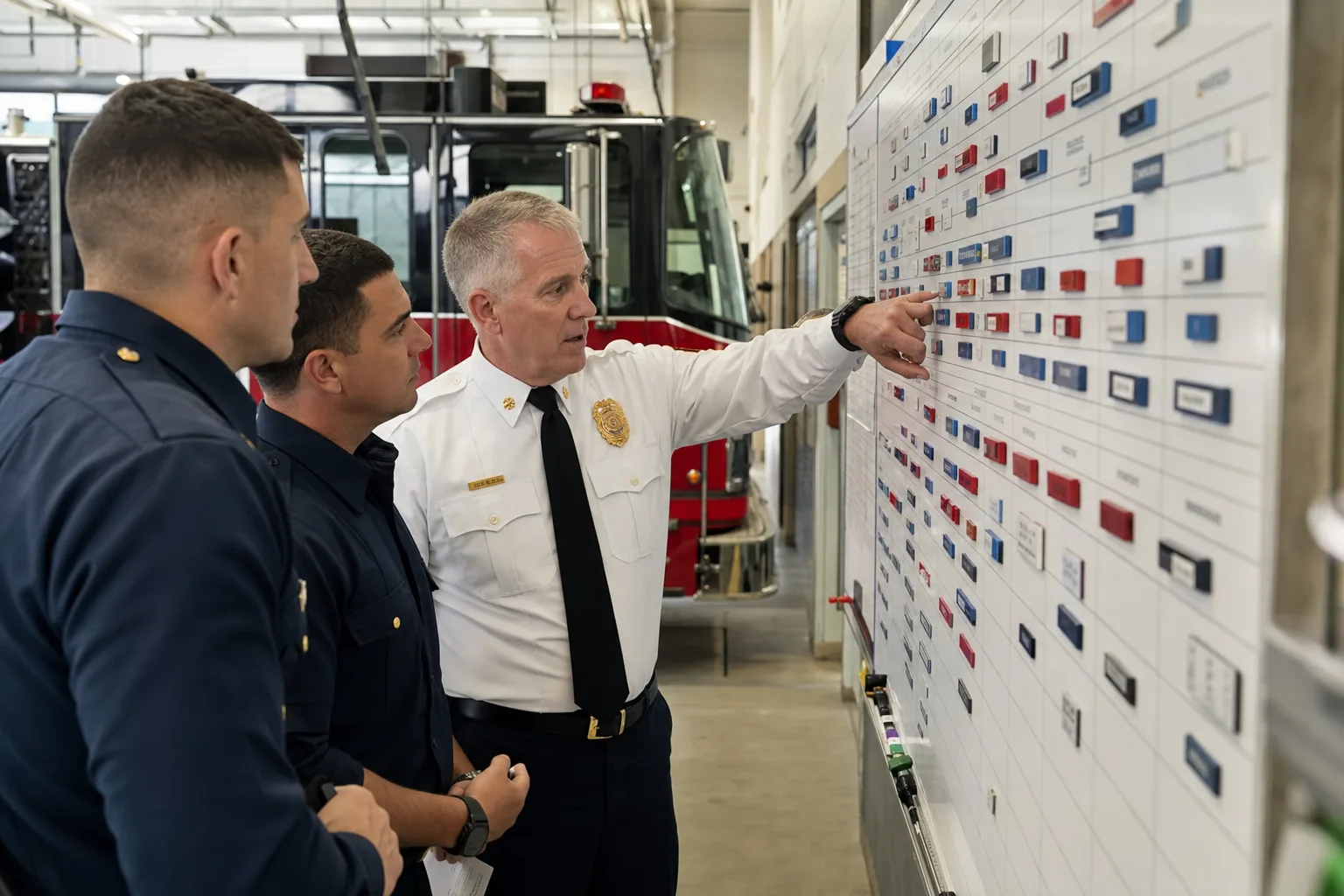
Firefighter hours vary by department, staffing model, labor agreement, and local coverage needs. Many career firefighters work 24-hour tours followed by 48 or 72 hours off. Others work 48 hours on and 96 hours off, split day-and-night tours, or another repeating rotation. Kelly days may periodically reduce scheduled hours. Overtime, callbacks, holdovers, training, and leave can change the hours actually worked.
Volunteer and combination departments may use duty crews, scheduled station coverage, availability rosters, or qualified callback pools instead of a single fixed rotation. The operational issue is not only how long a shift lasts. Departments must keep every station and apparatus staffed with the required number of qualified members throughout the schedule.
Common firefighter shift schedules
A firefighter schedule must provide continuous coverage while distributing tours among crews or platoons. A/B/C crews are common labels, but departments may use colors, numbers, or station-specific team names.
These are typical patterns, not universal standards:
| Schedule | Basic rotation | Average scheduled hours | Main staffing considerations |
|---|---|---|---|
| 24/48 | 24 hours on, 48 hours off | 56 per week across the cycle | Kelly days, leave relief, callbacks, and three-platoon coverage |
| 48/96 | 48 hours on, 96 hours off | 56 per week across the cycle | Fatigue exposure, two-day handoffs, leave spanning consecutive tours |
| 24/72 | 24 hours on, 72 hours off | 42 per week across the cycle | Four-platoon staffing and more crew handoffs |
| Split day/night tours | Commonly separate day and night shifts | Depends on the rotation | Handoffs, night staffing, rotation equity, and partial-shift leave |
| Volunteer duty crew | Assigned blocks such as nights or weekends | Department-defined | Availability, turnout qualifications, and unfilled duty blocks |
The average figures for the fixed rotations are mathematical cycle averages before overtime, callbacks, unpaid leave, or local hour-reduction practices. They do not determine compensation or legal compliance.
24 hours on, 48 hours off
Under a 24/48 schedule, A crew might report at 0700 Monday, B crew at 0700 Tuesday, and C crew at 0700 Wednesday. A crew then returns Thursday. The cycle repeats every three days rather than resetting with the calendar week.
This schedule averages 56 scheduled hours per week over the full rotation. Individual payroll weeks may show more or fewer hours depending on where tours fall. Departments often use Kelly days, debit days, or another local adjustment to reduce scheduled hours or align the rotation with an agreement.
A 24-hour tour means the member remains assigned and available for response for the full duty period. It does not mean the member is actively handling incidents every minute, and rest is not guaranteed. Calls, inspections, training, apparatus checks, station duties, public education, and reports all occur within the tour.
See 24/7 coverage scheduling for additional coverage design considerations.
48 hours on, 96 hours off
A 48/96 firefighter schedule keeps a three-platoon structure but combines two consecutive 24-hour tours. A crew reports once, remains on duty for 48 hours, and then has 96 hours off.
The pattern has the same 56-hour cycle average as 24/48, but it changes the operational risk profile. A busy first day can carry fatigue into the second day. A single leave request may also remove a member from two consecutive 24-hour periods. Departments considering this rotation should review call volume, nighttime activity, relief procedures, training requirements, and opportunities for temporary reassignment.
Safety issue—verify with the department’s authority having jurisdiction: Fatigue controls, rehabilitation practices, maximum consecutive work limits, and fitness-for-duty procedures should reflect local risk conditions and applicable standards. A rotation alone does not establish that a particular tour length is safe.
24 hours on, 72 hours off
The 24/72 firefighter schedule normally uses four platoons and averages 42 scheduled hours per week across the cycle. It can reduce scheduled hours compared with a three-platoon rotation, but it requires enough personnel to staff the fourth platoon.
The implementation question is whether the authorized headcount can support four complete crews after accounting for vacancies, leave, academy assignments, light duty, and long-term absences. Creating four crew labels without enough qualified personnel simply moves shortages into overtime or daily reassignment.
Split and non-24-hour schedules
Some departments use separate day and night tours, including combinations of 10-hour days and 14-hour nights. Others use 12-hour shifts, peak-demand units, or schedules tailored to airport, industrial, wildland, inspection, or support assignments.
These schedules require careful handoff rules. A partial-shift absence can affect two crews, and training scheduled near a shift boundary may produce additional hours. The department should define reporting time, relief time, meal or rest treatment, and responsibility when the incoming member is late.
Kelly days and scheduled-hour reductions
A Kelly day is a regularly scheduled day off inserted into a repeating rotation. Departments commonly use Kelly days to reduce average scheduled hours, balance labor agreements, or control overtime exposure. The frequency and assignment method are local decisions.
Kelly days may be:
- Permanently assigned to individual members.
- Rotated within a crew or classification.
- Selected by seniority or another contract process.
- Backfilled with relief personnel or overtime.
- Left unfilled only when coverage remains above the approved minimum.
The schedule should treat a Kelly day as a defined absence type, not an informal note. Otherwise, it can be omitted during a transfer, duplicated when a member changes crews, or overlooked when calculating available staffing.
A Kelly day does not automatically resolve wage-and-hour obligations. Its effect depends on the actual schedule, work period, compensation rules, and applicable agreement.
Scheduled hours are not the same as hours worked
A base rotation shows when a firefighter is expected to work. Actual hours can change through several mechanisms:
- Overtime: Additional work beyond the regular assignment, whether voluntary or mandatory.
- Holdover: Keeping an on-duty member past relief time, often until a replacement arrives.
- Callback or recall: Directing an off-duty member to return for an incident, staffing shortage, or special assignment.
- Shift trade or swap: Two eligible members exchange assignments under department rules.
- Working out of class: A member temporarily fills a higher or different classification, such as an acting officer assignment.
- Training or court time: Required activity may occur outside the normal tour.
- Leave: Vacation, sick leave, injury leave, military leave, or another approved absence changes availability but may be treated differently for payroll purposes.
Policies should distinguish these events. A callback minimum, holdover, and shift swap may look similar on a calendar but have different approval, pay, and recordkeeping rules.
FLSA and labor issue—verify with qualified counsel and the applicable authority: U.S. public fire departments may use the Fair Labor Standards Act Section 7(k) work-period framework when its requirements are met. Overtime calculations can depend on the adopted work period, hours treated as worked, regular-rate rules, sleep-time treatment, substitutions, and local law. Collective bargaining agreements, civil-service rules, and department policies may provide additional requirements. Scheduling software should apply the rules configured by the department; it should not be treated as legal advice.
Departments should also review whether state or local notice rules affect schedule changes. The predictive scheduling laws overview identifies questions to investigate, but applicability must be verified with counsel.
Staffing a shift by position and qualification
Knowing that four people are scheduled does not prove that an apparatus is deployable. Coverage must be evaluated against the department’s own staffing plan, apparatus assignments, and qualification rules.
For example, assume a department’s local plan calls for four members assigned to Engine 1, including an officer, an approved driver/operator, and a paramedic. Four available firefighters do not satisfy that plan if no one is qualified to drive or fill the officer seat. If one person holds several qualifications, the scheduler must still place that person in only one riding position at a time.
Multiple-station systems add another layer. Filling Station 1 by moving the only driver from Station 2 may fix one shortage while creating another. Coverage review should therefore show:
- Scheduled members compared with required positions.
- Apparatus and station assignments.
- Officer, driver/operator, medic, EMT, or specialty eligibility.
- Members on leave, training, light duty, or temporary assignment.
- Vacancies before and after transfers or overtime assignments.
- Whether a move affects another station’s minimum.
Departments can use a structured process to set minimum staffing levels and then configure the approved rules in the schedule. Minimum staffing is a local policy and safety decision; software should display and test the rule, not create it.
Managing call-offs, overtime, and shift swaps
A last-minute call-off should trigger a defined sequence rather than an improvised phone tree. The process may include confirming the absence, checking current staffing, considering an internal move, identifying qualified off-duty members, issuing an open shift, and escalating when no one accepts.
The policy should answer who can order mandatory overtime, how callbacks are prioritized, when a chief officer must be notified, and what happens if minimum coverage cannot be restored. See the guidance on a last-minute call-outs policy and how to handle understaffing.
Shift swaps need equal discipline. An officer-approved swap should confirm that the replacement:
- Is qualified for the position and apparatus.
- Is not already assigned elsewhere.
- Will not violate a department rest or consecutive-hours rule.
- Does not create an unapproved overtime or payroll issue.
- Accepts responsibility through a documented workflow.
Departments should define whether the original member remains responsible until approval and whether trades must occur within a specific pay or work period. The shift swap policy guide covers those decisions in more detail.
Firefighter hours in volunteer and combination departments
Volunteer hours are often less uniform than career tours. Members may submit availability, sign up for station duty, join a weekend duty crew, respond from home, or cover scheduled events. Combination departments may layer volunteer availability around a career crew’s fixed schedule.
Availability is not the same as an assignment. A member who says they are available from 1800 to 0600 has identified a possible coverage window; the department must still assign that member, confirm required qualifications, and communicate expectations. Guidance on employee availability management can also be adapted to duty-crew planning.
Volunteer scheduling should account for:
- Officer and driver coverage during each duty block.
- EMS licensure or local medical qualifications where required.
- Members who can respond but cannot staff a particular seat.
- Station-based duty versus response-from-home availability.
- Weekday daytime, overnight, and holiday gaps.
- Whether acceptance of an open shift is confirmed.
A scheduling platform manages planned rosters and availability. It is not a paging or CAD system and should not be used as a substitute for dispatch, incident reporting, or response accountability.
Labor and classification issue—verify with counsel: Paid-on-call, stipend, part-time, and volunteer arrangements can raise wage, tax, classification, and benefit questions. Departments should verify their model rather than infer legal status from the schedule label.
Using scheduling software to control firefighter hours
A fire department scheduling system should reproduce the department’s actual operations rather than forcing every member into a generic weekly calendar. Configuration should include custom rotations, shift boundaries, crews, station assignments, qualification rules, leave types, Kelly days, and approval authority.
Useful controls include:
- Rotation templates for A/B/C or four-platoon schedules.
- Separate shift types for regular duty, callback, holdover, training, and overtime.
- Scheduled-versus-required coverage views by station or apparatus.
- Qualification-based eligibility for open shifts and swaps.
- Notifications to the qualified pool rather than every member.
- Officer approval for trades and overtime assignments.
- Availability and time-off workflows.
- Web and mobile access with push, email, or in-app notices.
- Optional timekeeping when schedule and worked-time records need to be reconciled.
The schedule should preserve who requested, approved, declined, or changed an assignment. That audit trail helps administrators resolve discrepancies without relying on texts, paper calendars, or memory.
Operational implementation checklist
- Document every rotation, report time, relief time, and crew sequence.
- Load authorized positions and approved minimums by station and apparatus.
- Define which qualifications are required for each seat.
- Enter Kelly days and other recurring reductions as schedule rules.
- Separate regular duty, overtime, callback, holdover, training, and swap codes.
- Configure who may approve leave, swaps, overtime, and acting assignments.
- Establish the call-off escalation order and qualified notification pools.
- Test multi-station transfers to ensure they do not create a second shortage.
- Compare the published schedule with payroll or timekeeping records.
- Train members to verify assignments and acknowledge changes.
- Review fatigue, labor, FLSA, union-contract, and local-law questions with the appropriate authority.
- Run a trial cycle before retiring the previous scheduling process.
Common scheduling failure points
The most frequent operational breakdowns come from mismatched rules, not the name of the rotation. Watch for these conditions:
- Counting total personnel without checking officer, driver, or medic coverage.
- Tracking Kelly days in a separate spreadsheet that does not update the roster.
- Allowing a swap to bypass qualification or rest-rule checks.
- Sending an open shift to people who cannot fill the vacant position.
- Treating volunteer availability as a confirmed duty assignment.
- Filling one station by stripping another below its approved coverage.
- Publishing a calendar change without requiring acknowledgment.
- Recording scheduled overtime but failing to reconcile actual holdover or callback hours.
- Assuming the schedule determines FLSA or contract compliance.
A reliable firefighter schedule connects the repeating rotation to daily staffing decisions. The department still sets coverage, safety, labor, and approval rules; the scheduling process makes those rules visible when call-offs, leave, trades, and vacancies change the planned roster.
Frequently Asked Questions
- How many hours do firefighters usually work?
- There is no single standard. A 24/48 or 48/96 rotation averages 56 scheduled hours per week across its cycle, while 24/72 averages 42. Overtime, callbacks, Kelly days, leave, and local agreements change the hours actually worked.
- Do firefighters work for the entire 24-hour shift?
- A firefighter assigned to a 24-hour tour remains on duty and available for response throughout the shift. The tour can include emergency calls, training, inspections, station duties, meals, reports, and rest periods, but uninterrupted sleep is not guaranteed.
- What is a Kelly day in a fire department?
- A Kelly day is a scheduled day off inserted into a repeating rotation to reduce scheduled hours or meet a local labor arrangement. Its frequency, selection method, backfill process, and payroll treatment depend on department policy and any applicable agreement.
- Are 48/96 shifts the same total hours as 24/48 shifts?
- Yes, both rotations average 56 scheduled hours per week across the complete cycle. They arrange the hours differently: 24/48 uses one day on and two off, while 48/96 combines two duty days followed by four days off.
- How should departments schedule volunteer firefighter coverage?
- Separate availability from confirmed assignments, define duty blocks, and check officer, driver, EMS, and other required qualifications. Open-duty notifications should go to eligible members, with acceptance recorded before the member is counted toward planned coverage.
Ready to replace the spreadsheet and group text?
Build the rotation, publish shifts, and see qualified coverage in ShiftSynch.
Start free