How Long Does a Firefighter Work? Shifts and Rotations
Learn how 24/48, 48/96, shorter shifts, overtime, callbacks, leave, and relief coverage shape firefighter work hours and station staffing.
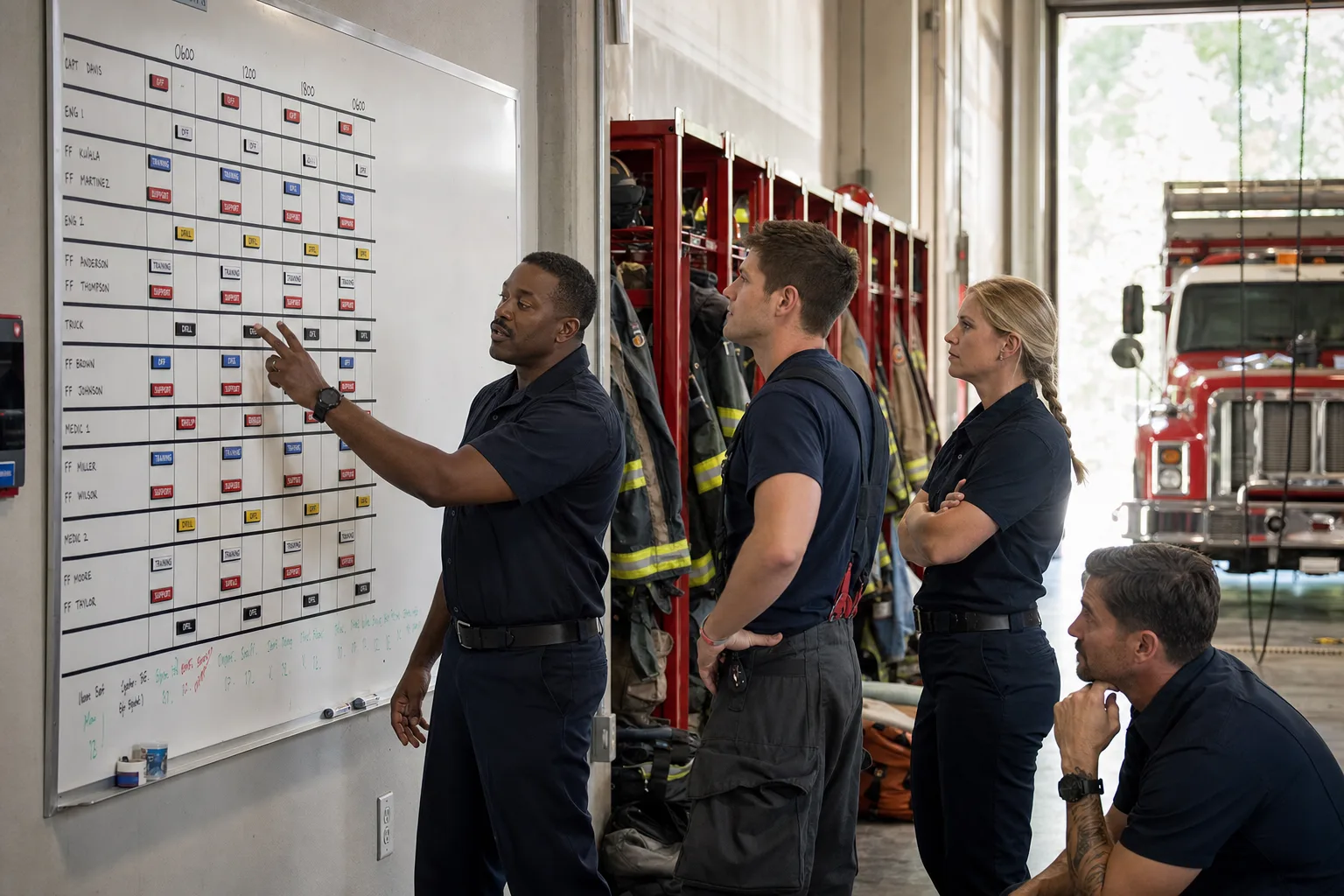
A firefighter may work a 24-hour shift followed by 48 or 72 hours off, two consecutive 24-hour shifts followed by 96 hours off, or shorter 8-, 10-, or 12-hour shifts. There is no single schedule used by every department. Actual hours depend on the rotation, work period, overtime, callbacks, training, leave, shift trades, and whether relief arrives on time. Career departments often staff stations continuously with rotating platoons, while combination and volunteer departments may blend career shifts, duty crews, on-call availability, and station coverage. For chiefs and schedulers, the practical question is not only how long one shift lasts. It is whether every apparatus and station maintains the required officer, driver/operator, firefighter, and medical qualifications throughout that shift.
Common firefighter shift lengths and rotations
Structural fire and emergency response require coverage around the clock, but departments organize that coverage in different ways. Rotation design is usually shaped by staffing levels, call volume, station count, budget, labor agreements, fatigue concerns, and local operating practices.
A long shift does not mean a firefighter is continuously handling incidents for the entire period. A station shift can include apparatus checks, training, inspections, preincident planning, public education, meals, station duties, physical fitness, reports, and rest when conditions permit. Calls, move-ups, mandatory training, and other assignments interrupt that routine.
| Pattern | Basic rotation | Nominal scheduled average | Common scheduling concerns |
|---|---|---|---|
| 24/48 | 24 hours on, 48 hours off | 56 hours per week before relief days or other adjustments | Frequent reporting days, overtime holdovers, leave backfill, fatigue at busy stations |
| 48/96 | 48 hours on, 96 hours off | 56 hours per week before adjustments | Long continuous tours, travel benefits, second-day fatigue, managing partial-shift leave |
| 24/72 | 24 hours on, 72 hours off | 42 hours per week | Usually requires four platoons; transitions and relief coverage still matter |
| 10- and 14-hour shifts | Often day and night tours divided between platoons | Depends on the repeating cycle | More shift changes, day/night balance, handoffs, and separate leave blocks |
| 12-hour shifts | Day/night tours, often in repeating blocks | Depends on the cycle | Night rotation, weekend distribution, and more frequent relief points |
| 8-hour shifts | Three daily tours or mixed staffing assignments | Depends on the weekly pattern | Additional handoffs and difficulty aligning operations, training, and overtime |
| Volunteer or combination duty crew | Scheduled station duty, on-call periods, or both | Varies widely | Availability, turnout reliability, qualified crew assembly, and career-volunteer coordination |
The nominal averages in the table describe the underlying cycles, not necessarily paid hours, contractual hours, or the hours an individual will actually work. Relief days, sometimes called Kelly days or debit days depending on local terminology, may periodically remove a member from a scheduled tour. Departments should use the terms and rules established in their own policies and labor agreements.
How the 24/48 schedule works
Under a 24/48 rotation, a firefighter works for 24 hours and then has 48 hours off. Three platoons—often called A, B, and C—can rotate through the schedule so one platoon is assigned each day. Over a repeating three-week period, each platoon is scheduled for seven 24-hour tours, or 168 hours. That produces a nominal average of 56 scheduled hours per week before relief days, leave, overtime, or other adjustments.
The apparent simplicity can hide staffing problems. If an A-shift driver/operator calls off, the department cannot assume that any available firefighter can fill the seat. The replacement must satisfy the department’s apparatus qualification, assignment, and acting-rank rules. If no qualified relief is available, a member may be held over, recalled, reassigned from another station, or offered overtime under the applicable procedure.
Departments using this pattern need clear rules for partial-tour leave. A member taking 12 hours off a 24-hour tour creates a different vacancy than someone missing the full shift. The schedule must show exactly when the vacancy starts and ends so the relief member is not assigned for the wrong period. More detail is available in this guide to 24/7 coverage scheduling.
How the 48/96 schedule works
A 48/96 rotation places two consecutive 24-hour periods on duty, followed by 96 hours off. It commonly uses the same three-platoon structure and has the same nominal 56-hour weekly average before local adjustments. The difference is how the hours are grouped.
Grouping tours can reduce reporting days and provide longer off-duty blocks. It also creates a longer continuous duty period. Busy stations, interrupted sleep, late incidents, training schedules, and interfacility assignments can make the second 24 hours operationally different from the first. Departments considering this arrangement should assess activity by station and unit rather than relying only on department-wide call totals.
A transition also needs a dated conversion plan. Common failure points include placing one platoon into an unintended extra tour, applying leave balances to the wrong date, or overlooking an approved trade during the cutover. Build and audit several complete cycles before publishing the new calendar. The 48/96 firefighter schedule guide covers the rotation in greater depth.
Shorter tours and mixed schedules
Not every firefighter works 24-hour tours. Departments may use 8-, 10-, 12-, or 14-hour shifts for suppression personnel, dispatch-related assignments, inspections, community risk reduction, logistics, training divisions, or peak-demand companies. Some systems pair 10-hour day shifts with 14-hour night shifts. Others use 12-hour tours or add daytime staffing when calls are heaviest.
Mixed schedules complicate comparisons. A firefighter assigned to a 40-hour prevention position and a firefighter assigned to a platoon may have different base calendars even if both can be recalled for major incidents. A combination department might place career personnel on 24-hour tours while volunteers sign up for overnight duty crews or weekend station shifts.
Schedulers should keep each schedule type distinct while showing how they interact. A daytime firefighter temporarily assigned to line coverage may need a different leave conversion, overtime treatment, or qualification check. Those are policy, labor, and payroll questions that the department must resolve before the schedule is configured.
Why actual hours differ from the posted rotation
The shift calendar establishes planned hours. Actual hours change when operational events and personnel actions affect that plan.
Overtime, holdovers, and callbacks
An off-going firefighter may be held past relief when the incoming member is absent, an incident extends beyond shift change, or the department cannot immediately fill a required position. A callback brings an off-duty member back for an emergency, staffing shortage, or other authorized need. Overtime may also cover vacancies, special events, wildland deployments, or training.
Schedulers need to distinguish the reason for the extra time. A planned overtime vacancy, emergency callback, late relief, and incident extension may require different approval and payroll coding under local rules. Combining all extra hours into one generic label makes audits and fatigue reviews harder.
Leave and call-offs
Vacation, sick leave, injury leave, military leave, training leave, and other approved absences can create full- or partial-shift openings. A good last-minute call-off policy identifies who receives the notice, who creates the vacancy, how qualified personnel are contacted, and who can authorize overtime or a staffing adjustment.
Failure often occurs when the leave calendar and staffing roster are separate. A request can be approved without anyone recognizing that it removes the only medic from a company or drops a station below its staffing target.
Shift trades
A trade changes who works the assignment, but it should not erase the underlying responsibility or qualification requirement. Departments need rules covering approvals, pay-period boundaries, repayment deadlines, partial-shift trades, overtime interaction, and what happens if the substitute later calls off. These are policy and labor-agreement issues to verify locally. A written shift-swap policy helps supervisors apply the same process across platoons.
Training and special assignments
Training may occur during a normal tour, before or after a shift, or on an off-duty day. The staffing impact depends on whether the member remains available for response. Sending two driver/operators to an off-site class can create a coverage problem even when both still appear assigned to their regular company.
Schedulers should identify whether each assignment is in station, off site but recallable, or completely unavailable. The distinction matters when counting operational strength.
Scheduled hours are not the same as coverage
A roster can show enough names and still fail operational requirements. Coverage must be measured against positions and qualifications, not only headcount.
For example, suppose Station 1 requires four members on an engine, including an officer and qualified driver/operator, while Station 2 requires a medic-capable crew. Eight scheduled firefighters do not satisfy the plan if both officers are assigned to Station 1 or the only medic is in training.
Departments should define minimums at the level they actually manage. That may include:
- Department-wide on-duty strength
- Minimum staffing by station or battalion
- Apparatus staffing targets
- Required officer or acting-officer coverage
- Driver/operator or apparatus-specific qualification
- Paramedic, EMT, or other medical credential
- Specialty team obligations
- Rules for cross-staffed apparatus
The distinction between a minimum and a target should be explicit. A minimum may trigger mandatory backfill, while a target may allow command discretion. Departments should document who can alter unit status or approve staffing below a target. The process in setting minimum staffing levels can help structure those decisions.
Building a workable firefighter schedule
A rotation should be tested as an operating system, not just drawn as a repeating calendar. Use the following implementation checklist before publishing a new pattern or revising an existing one.
Scheduling implementation checklist
- Define the shift start time, tour length, and exact repeat cycle.
- Assign A/B/C crews, four platoons, or other teams to dated rotations.
- List minimum staffing by station, apparatus, rank, and qualification.
- Decide how relief days, holidays, and partial-shift leave are represented.
- Document the order for filling vacancies: trade, voluntary overtime, callback, reassignment, or other approved method.
- Set approval authority for leave, swaps, open shifts, and acting assignments.
- Confirm how members on training or special details count toward coverage.
- Test call-offs involving officers, drivers, medics, and members with multiple qualifications.
- Audit several cycles for excess hours, uncovered positions, and unfair weekend or holiday distribution.
- Define the official source for payroll and resolve differences between scheduled and worked time.
- Publish the schedule far enough ahead for members and supervisors to review it.
- Establish a correction process for missed trades, duplicate assignments, and qualification records.
One common implementation error is building the ideal rotation without testing absences. Run scenarios such as a medic calling off at 0500, a driver attending three days of training, two overlapping vacations, or a major incident continuing through shift change. If the process depends on one scheduler remembering every exception, it is not resilient.
Managing rotations with scheduling software
A dedicated fire department scheduling layer should represent the actual rotation and test assignments against coverage requirements. It is different from CAD, paging, incident reporting, records management, asset management, and certification-expiry tracking. Those systems may exchange information through department-specific processes, but they serve different operational purposes.
Useful scheduling functions include custom rotating shifts, crews or teams, availability, time-off requests, officer-approved swaps, open shifts, and qualification-based eligibility. Scheduled-versus-required analytics can show whether the roster meets the department’s configured coverage plan rather than merely counting scheduled people.
For an open driver/operator shift, the notification pool should exclude members who do not meet the department’s configured eligibility rules. For a medic vacancy, the scheduler should be able to identify available, qualified members without sending the offer to the entire department. Final assignment authority should remain aligned with department policy.
Optional timekeeping can record deviations between planned and worked hours, but departments must still decide which system is authoritative for payroll. More implementation considerations appear in the guides to fire department scheduling software and firefighter scheduling.
Compliance, labor, and fatigue checks
Firefighter schedules can involve the Fair Labor Standards Act, including the Section 7(k) work-period rules that may apply to eligible public agencies, as well as state law, local rules, collective bargaining agreements, and department policy. Departments must verify wage-and-hour treatment, overtime thresholds, callback pay, substitutions, sleep time, compensatory time, and recordkeeping with their own counsel, labor authority, payroll specialist, and applicable agreement. A schedule template does not determine legal compliance.
Predictive or fair-workweek scheduling laws may apply differently by jurisdiction and employer type. Departments should verify local coverage rather than assume emergency services are included or exempt. See the predictive scheduling laws overview as a starting point for questions to take to local counsel.
Fatigue is also a safety and operational issue for the department’s authority having jurisdiction to evaluate. Consecutive overtime, callbacks during off-duty periods, station activity, commute time, and secondary employment can affect recovery even when the base rotation appears balanced. Supervisors need visibility into total assigned hours and recent extensions, not just the next open slot.
The clearest answer to how long a firefighter works is therefore a range, not one number. Shift length establishes the basic tour, while staffing rules, relief practices, leave, trades, overtime, callbacks, and training determine the hours actually worked. A reliable schedule connects every hour to a qualified assignment and shows command staff where coverage is met, at risk, or unresolved.
Frequently Asked Questions
- How many hours does a firefighter work in a week?
- It depends on the department's rotation. A basic 24/48 or 48/96 cycle averages 56 scheduled hours per week before relief days and other adjustments. A 24/72 rotation averages 42 hours, while 8-, 10-, and 12-hour schedules vary by cycle. Overtime, callbacks, leave, trades, and training can change the hours actually worked.
- Do firefighters work for the full 24 hours of a 24-hour shift?
- They are assigned for the full tour, but the work varies throughout it. A shift may include emergency responses, apparatus checks, training, inspections, station duties, reports, meals, and rest when conditions permit. Call volume and overnight activity differ significantly by station and unit.
- What is the difference between a 24/48 and a 48/96 schedule?
- A 24/48 schedule alternates one 24-hour tour with 48 hours off. A 48/96 schedule groups two 24-hour periods together, followed by 96 hours off. Both have a nominal 56-hour weekly average before local adjustments, but they differ in reporting frequency, continuous duty time, and relief planning.
- How should a department fill an open firefighter shift?
- Follow the department's approved vacancy process and check the assignment's rank, apparatus, medical, and specialty qualifications. The process may include approved trades, voluntary overtime, qualified-pool notifications, callbacks, holdovers, or station reassignments. Departments must verify pay, labor-agreement, fatigue, and minimum-coverage requirements with their own authorities.
Ready to replace the spreadsheet and group text?
Build the rotation, publish shifts, and see qualified coverage in ShiftSynch.
Start free